
Jefferson, Ste. Genevieve & St. Louis counties
Septic installation and replacement.
J1S is licensed by the State of Missouri as an advanced onsite wastewater installer. That covers conventional gravity systems and the engineered systems a difficult lot needs: drop box, low pressure pipe, and drip. We install new systems and replace failed ones in Jefferson County, Ste. Genevieve County, St. Louis County, and the counties around them.
State license
Advanced Onsite Wastewater Installer
Licensed through the Missouri Department of Health and Senior Services. Missouri allows only advanced installers to install the systems it lists as advanced.
Why the advanced license matters
Missouri requires anyone who installs a septic system to be licensed through the Department of Health and Senior Services. There are two levels. A basic installer is trained on conventional systems. An advanced installer has completed additional state training in advanced treatment, pressure distribution, low pressure pipe, and drip systems. Each level requires a state-approved course passed with a score of 70 percent or higher, and the license expires after 36 months unless it is renewed with continuing education.
The difference matters when the soil report comes back. Much of Jefferson County is shallow soil over limestone, on slopes. Lots like that often cannot take a conventional system. If your site needs an engineered system, an installer licensed only at the basic level cannot build it. J1S can install either kind, so the design does not send you looking for a second contractor.
Types of septic systems we install
Every system has the same two jobs: settle the solids in a tank, then spread the liquid into soil that can treat it. The types differ in how the liquid gets to the soil.
| System | How it moves wastewater | What is in the yard | Typical site |
|---|---|---|---|
| Conventional gravity | Gravity, from the tank to level trenches | Drain field of stone-filled trenches | Deep, well-draining soil on gentle ground |
| Drop box | Gravity, trench to trench down a slope | Drain field stepped down the hill | Suitable soil on a hillside |
| Low pressure pipe (LPP) | Pump, in timed doses through small pipes | Drain field of narrow, shallow trenches | Shallow or slow soil, seasonally high water table |
| Drip system | Pump, through drip tubing in a grid | Tubing a few inches down, in place of trenches | Shallow soil, irregular lots, wooded sites |
Every one of these has a drain field, the part of the yard where the soil treats the wastewater. The first three use trenches. A drip system is named for its drip tubing, which does the same job without trenches.
Conventional gravity systems
This is the system most people picture when they think of septic tank installation. Wastewater flows by gravity from the house to a septic tank, where solids settle. The liquid then flows to a distribution box and out into a set of level trenches, called the drain field or leach field. Perforated pipe in each trench lets the liquid seep into the soil, which does the final treatment.
A conventional system has no pump and few parts, so it is usually the least expensive to install and to own. It needs soil that drains at a suitable rate, enough depth above rock and groundwater, and room for the field.
Drop box systems for sloped lots
On a hillside the trenches cannot all sit at one level. A drop box system, also called serial distribution, steps them down the slope. Each trench runs along the contour, and each has a drop box at its head. The first trench fills, then the overflow passes through the drop box to the trench below it, and so on.
It is still a gravity system, with no pump. It lets a sloped lot with good soil use a conventional design, and each trench is used fully before the next one takes flow.
Low pressure pipe (LPP) systems
An LPP system adds a pump tank after the septic tank. The pump sends wastewater in timed doses through small perforated pipes, one to two inches across, laid in narrow trenches that are generally no more than 12 inches deep. Because the lines are under pressure, the whole field receives an even dose instead of the first few feet taking most of it.
Missouri's construction standards describe LPP as an option where shallow soil, a seasonally high water table, or slow soil rules out a conventional system. An LPP system is designed by a Missouri-registered engineer, and it is one of the systems that takes an advanced installer. Read more about LPP septic systems.
Drip systems
A drip system doses treated wastewater through flexible tubing with small emitters, laid in a grid a few inches below the surface. The tubing can follow the contour and weave between trees, so it fits lots where trenches would not. It uses a pump, filters, and controls, and it normally follows a treatment unit that cleans the wastewater before it reaches the tubing.
Drip is the most equipment-heavy of these systems and needs regular service. It is also the one that makes some difficult lots buildable. Read more about drip septic systems.
Other engineered systems
A design may also call for an elevated sand mound, a sand filter, an aeration unit, or a lagoon, depending on the soil and the size of the property. If your design specifies one of these, send it with your request and we will tell you plainly whether it is work we take on.
Sizes and setbacks in Missouri
These figures come from Missouri's minimum construction standards for septic systems. They are state minimums. A county can require more, and the approved design for your property controls.
How big a septic tank do I need?
Missouri sets the minimum tank size by the number of bedrooms: 1,000 gallons for one to three bedrooms, 1,250 gallons for four, and 1,500 gallons for five. A house with six or more bedrooms is sized from its daily flow.
How much wastewater is a septic system designed for?
Missouri's standards use 120 gallons a day for each bedroom, with a minimum of 240 gallons a day for any house. A three-bedroom house is designed for 360 gallons a day, whoever lives in it.
How far does a septic system have to be from a well?
The drain field must be at least 100 feet from a private well, and the tank at least 50 feet. The state's other common setbacks are below.
| Measured from | Septic tank | Drain field |
|---|---|---|
| Private well | 50 feet | 100 feet |
| Stream, lake, or pond | 50 feet | 50 feet |
| Property line | 10 feet | 10 feet |
| House foundation | 5 feet | 15 feet |
| Basement foundation | 15 feet | 25 feet |
How deep is a drain field trench?
A standard trench is 18 to 36 inches wide, and its bottom sits 18 to 30 inches below the finished grade. The standards also require at least one foot of soil between the trench bottom and rock or the seasonal high water table, and no single trench may run longer than 100 feet without approval.
Does a lot of three acres or more need a septic permit?
Missouri law exempts a single-family lot of three acres or more from the state's septic permit rules, as long as every part of the system is more than 10 feet from the property line and no wastewater leaves the property or reaches surface water or groundwater. Lots next to a Corps of Engineers or public utility lake are not exempt, and a county with its own septic ordinance can still require a permit. Ask the permitting office for your address before you plan around the exemption.
The soil chooses the system
You do not pick a septic system from a list. A soil evaluation comes first. A qualified soil evaluator examines the soil in test pits and reports how it absorbs water and how deep it is to rock or a seasonal water table. Some sites still use a percolation test, often called a perc test. The result sets what types of system the permitting office will approve and how large the field has to be.
The number of bedrooms sets the design flow. Setbacks from wells, property lines, buildings, and streams limit where the system can go. On a small or steep lot, those limits often decide the system type as much as the soil does.
The soil evaluator and, for engineered systems, the design engineer are separate professionals from the installer. J1S builds from the approved design. If you are at the beginning and have neither yet, tell us, and we will walk you through the order of steps.
How a septic installation goes
- Permit in hand. The soil report and system plan are approved before any digging.
- Layout. The tank, lines, and field are staked from the plan. Buried utilities are located first.
- Excavation. The tank hole and trenches are dug to the depths on the plan. Trench bottoms are kept level, and equipment stays off the field area so the soil is not compacted.
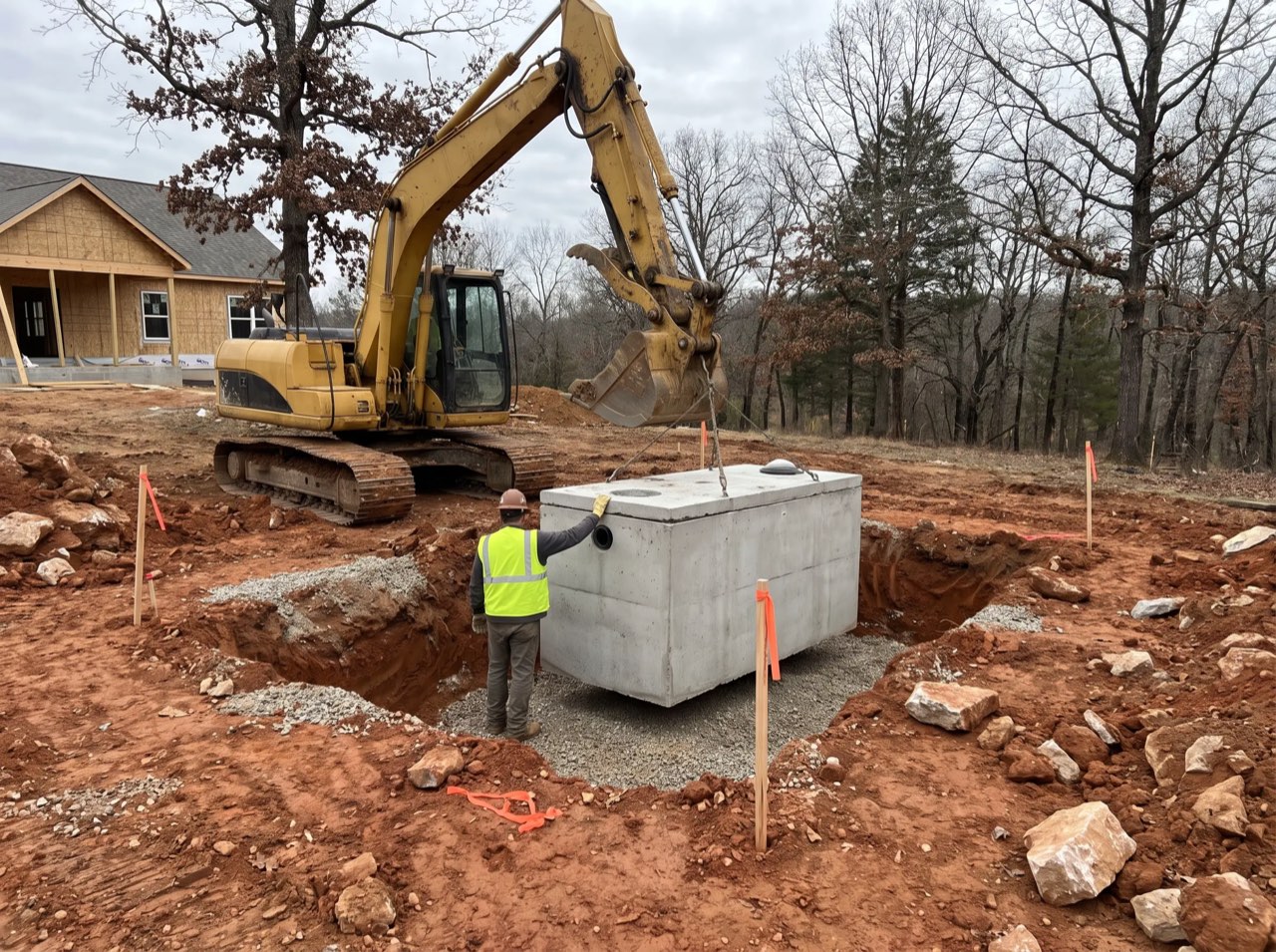
- Tank and components. The tank is set level on a firm base. A pump tank, controls, and electrical connections are added for pressure systems.
- Field. Pipe, rock or chambers, drop boxes, or pressure laterals go in as designed.
- Inspection. The system is inspected before it is covered.
- Backfill and grade. The system is covered and the surface is shaped so rain runs away from the tank and field.
Rock is the common surprise in this area. J1S owns its hydraulic hammer, so when a tank hole hits rock, we break it and keep the job moving. For a new home, the septic work fits into the larger site sequence described in excavation for new home construction.
Replacing a failed septic system
Wet ground or odor over the field, slow drains through the whole house, and sewage backing up at the lowest drain are the usual signs. Stop driving or parking on the area, cut water use, and have the tank and field checked.
A replacement goes through the same soil and permit steps as a new system. The original field often cannot simply be rebuilt, because the soil there is the reason it failed. Expect the replacement to sit in a different spot or to be a different type. Local codes can also set conditions on replacing a tank on an existing system, so confirm the requirements before work is priced. Our septic replacement page covers the warning signs and what to do first.
If your home is on public sewer and the problem is the line to the street, that is a different job. See sewer and water repair.
Where we install septic systems
J1S is based in Festus and installs septic systems across the counties south and west of St. Louis. Much of this area is outside public sewer, on rolling ground with shallow soil over rock, which is where system choice matters most.
Jefferson County
Festus, Crystal City, Herculaneum, Pevely, Barnhart, Imperial, Arnold, Hillsboro, De Soto, and the rural parts of the county between them.
Ste. Genevieve County
Ste. Genevieve, Bloomsdale, St. Mary, and the farms and rural lots across the county. Most homes outside the towns rely on a septic system.
St. Louis County
The unsewered parts of the county, mainly in the west and south: Wildwood, Chesterfield, Ballwin, Town and Country, Fenton, and Oakville.
Neighboring counties
We also take septic work in St. Francois, Washington, and Franklin counties. If your property is somewhere else nearby, send the address and we will tell you.
Each county runs its own permitting, and some require their own installer license or inspection steps on top of the state license. Send the exact address with your request so we can confirm the requirements for your property before the work is priced. We also handle the site excavation, grading, and stone delivery that go with a new system.
Common questions
Septic systems
What is an advanced onsite wastewater installer?
Missouri licenses septic installers at two levels. A basic installer may install conventional systems. An advanced installer has completed further state training and may also install the systems Missouri lists as advanced, which include pressure distribution, low pressure pipe, and drip systems. J1S is licensed at the advanced level.
Which septic system will my property need?
The soil decides. A soil evaluation measures how well the ground can absorb and treat wastewater and how deep it is to rock or groundwater. Good, deep soil on a gentle site usually allows a conventional gravity system. Shallow soil, slow soil, a high water table, or a steep slope usually calls for an engineered system.
What is a drop box septic system?
It is a conventional gravity system built for a slope. The trenches follow the contour of the hill, one below the next. A drop box at the head of each trench fills that trench first, then passes the overflow down to the next one. It lets a gravity system work where the ground is not level.
What is a low pressure pipe system?
A low pressure pipe system, or LPP, uses a pump to push wastewater in timed doses through small perforated pipes laid in shallow trenches. Dosing spreads it evenly across the whole field and keeps it in the upper soil. It is used where the soil is shallow or slow, or where the water table is seasonally high.
How much does a septic system cost?
It depends on the system the soil requires. A conventional gravity system costs the least because it has no pump and the fewest parts. Low pressure pipe and drip systems cost more: they add a pump tank, controls, electrical work, and an engineered design. Rock in the tank hole, a long run from the house, tree clearing, and tight access also add cost. We quote from the approved design and a look at the site, so send the soil report and plan if you have them.
Do I need a permit to install or replace a septic system?
Yes, in most cases. The permit is issued by the county or the state depending on where the property is, and it normally requires a soil evaluation and a scaled plan of the system. The system is inspected before it is covered. Confirm the requirements for your property with the permitting office before work is priced.
Can you replace a failed drainfield or tank?
Yes. Replacement starts the same way a new system does: with the soil and the permit. A drainfield that failed in a given spot often cannot be rebuilt the same way in the same place, so the replacement may be a different type of system. Send what you know about the existing system and what is happening.
Not sure where to start? Send us your address.
Tell us whether it is a new home or an old system that needs replacing. You do not need a soil test or a plan yet. We will explain what comes first and what it involves.
Request a septic quote Call (636) 331-5757