
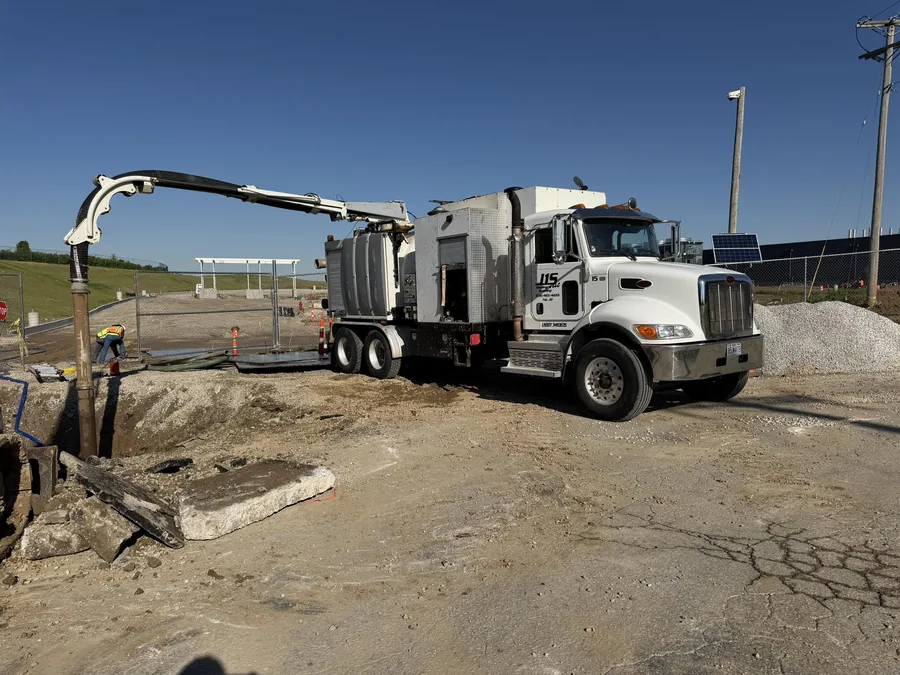
Hydrovac excavation for buried lines and utility crossings.
Utility potholing, daylighting, and repair access using water and vacuum excavation. An owner-operated crew serving the St. Louis metro and Jefferson County. Send the site plan and tell us what needs to be exposed.
 NULCA Certified
Soil cuts
with water,
not steel.
Hydrovac goes by several names. Hydro excavation, hydro vacuum excavation, hydro excavating, and vacuum excavation all describe the same service. It is a non-destructive method of digging that uses two things at once: high-pressure water to break up soil into a slurry, and an industrial vacuum to remove the slurry into a sealed debris tank on a truck.
The result is a precise, clean hole — exactly the size and depth you asked for — with controlled soil removal around buried utilities. The method still requires utility verification, trained operation, and suitable settings. It helps crews expose lines at crossings and repair points.
J1S runs its hydrovac from Festus across the metro. See hydro excavation in St. Louis for city work, or utility potholing for exposing a line before a trench or bore. The same truck runs vacuum truck service for basins, pits, and bore slurry.
Expose the line before planning the crossing or repair.
How a hydrovac truck
exposes buried utilities.
A water jet loosens the ground. A vacuum carries the soil away. Scroll through the four stages of a dig, from the locate marks to the line you can see and measure.


-
Step 1 of 4 · Before the water starts
Know where to dig.
Utility marks and available records guide the dig plan. The truck parks within reach, and the boom places the vacuum hose over the spot.
Marks show an approximate location. Exposing the line is what confirms its real position and depth.
-
Step 2 of 4 · Water to the ground
Water does the cutting.
Water runs from the truck to a hand-held wand. Its jet loosens the soil into a mix of water and dirt called slurry.
The operator sets the water for the ground and for what is buried in it. Digging near a line still takes care.
-
Step 3 of 4 · Ground to the tank
Vacuum takes it away.
The blower moves air that carries the loosened soil and water up the vacuum hose. The slurry collects in the debris tank on the truck.
Water and vacuum work together as the hole gets deeper. The spoil stays separate from the clean water supply.
-
Step 4 of 4 · See what is below
Now the line is visible.
With the soil gone, the crew can see and measure the utility. The dig is photographed and measured, and the spoil is hauled to a permitted disposal site.
You receive the documentation with the close-out package.
Get a hydrovac quote
Where hydrovac fits
the excavation plan.
Mechanical excavation is faster and cheaper for bulk dirt work — that's why we still do plenty of it. But for these six specific scenarios, hydroexcavation is meaningfully safer, cleaner, or both.
Daylighting Utilities
Exposing buried gas, electric, water, fiber, or sewer lines so you can verify their condition or location before tying in or trenching nearby.
Potholing
Small precision holes (12"–24") to confirm depth and location of underground assets before designing or installing crossings.
Slot Trenching
Narrow, clean trenches for fiber, conduit, or irrigation runs — at half the disturbance and a fraction of the restoration cost.
Frozen & Hard Ground
Heated water cuts winter clay and summer hardpan that would stall a mechanical bucket. Keeps your project on schedule year-round.
Tree-Sensitive Work
Working around mature trees without severing root systems. Critical for landscape preservation projects and arborist-supervised digs.
Tight & Live Sites
Pedestrian zones, occupied buildings, active industrial facilities, and sites where heavy equipment access is limited or unsafe.
When does each
method make sense?
Both methods have a place — and we run both. Use this as a quick guide for which makes sense on your project. When in doubt, ask us.
Our hydrovac
by the numbers.
We chose this unit specifically because it can handle the regional soil types, the climate, and the kind of jobs we get called for most often. Here's what's under the hood.
Hydrovac work in St. Louis and Jefferson County.
Send the site address, what needs to be exposed, and a marked-up plan or photos. For utility potholing, identify each crossing or verification point and the measurements the next crew needs. For repair access, tell us which contractor is doing the repair and how much working room they need.
Locating, access, and completion
Confirm the 811 process and any private locating before work starts. Surface marks do not establish depth. Read what locating and potholing each tell you if you are deciding which work belongs in the scope.
The quote should address truck position, opening hard surfaces, water, spoil handling, backfill, and restoration. A paved commercial site and an open residential lot can need different arrangements for the same exposure. Use the hydrovac quote checklist to put those details in one request.
For a defined set of exposure points, see utility potholing and daylighting. Planning a winter job? Read about hydrovac work in frozen ground.
We serve St. Louis hydrovac jobs and Jefferson County utility work. Give dispatch the requested date and site restrictions so the truck and crew can be scheduled for the actual scope.
Hydrovac access,
depth, and disposal questions.
These are the questions we hear from contractors, builders, and municipalities trying to figure out whether hydroexcavation is the right call for their project.
How much does a hydrovac job cost vs. mechanical excavation?
Per cubic yard, hydro is more expensive — usually 2–4x mechanical, depending on the site. But that comparison misses the point. Hydro pays for itself the moment it prevents a single utility strike (which can run $20K–$200K in repair plus regulatory fines). On the right job, it's the cheaper option by a wide margin.
How much does hydro excavation cost per hour in Missouri?
Ask for a site-specific quote that identifies the rate or price basis, mobilization, crew, water, spoil handling, and any minimum charge. Depth, ground conditions, access, and coordination affect the total. Send the address and exposure points so dispatch can price the defined work.
What kinds of soil can the hydrovac handle?
Most native soils — clay, loam, sand, silt, and most gravelly soils. Heated water lets us cut frozen ground and hardpan that would stall a mechanical bucket. We can usually work through small cobble. For solid rock or bedrock, mechanical or pneumatic methods are still the right call.
How deep can you dig with hydroexcavation?
Practically, our setup can reach about 30 feet on most sites. Beyond that, the vacuum efficiency drops and the economics shift. For typical utility-locate, potholing, and slot-trench work — usually 4 to 12 feet — we're well within the sweet spot.
Do you need water and power on site?
No. Our truck carries 1,500 gallons of water on board, runs off its own diesel, and is fully self-contained. We can refill from a fire hydrant (with permit) or a static source if a long-duration job needs it. Otherwise, we're plug-and-play.
What happens to the slurry?
It goes into our sealed 12-yard debris tank and gets hauled to a permitted disposal site. Disposal is included in our quote. We'll provide manifests for your records if your project requires them (LEED projects, government work, etc.).
Do I need a permit for hydroexcavation work?
Same as any excavation work — depends on jurisdiction and scope. Tap-ins and right-of-way work usually need permits regardless of method. We handle permit acquisition for our part of the work as part of the project, or coordinate with your GC's permit pull.
How quickly can you get a hydrovac on site?
For scheduled work: typically 5–10 business days from quote acceptance. For emergencies (utility strikes, water main breaks, line locates needed before a permit pull), call our emergency hydrovac line direct: (636) 465-4226. We can usually be on site within 24 hours.
Hydrovac service across
St. Louis & Jefferson County.
Based in Festus — we run hydrovac jobs throughout Jefferson County and the St. Louis metro. Short lead times, fast mobilization.
Mark the exposure points.
Send us the site plan.
Send us the address, the scope, and what you're trying to expose, install, or avoid. We'll quote it and get on the schedule.