
Jefferson, Ste. Genevieve & St. Louis counties
Septic and drain field replacement.
When a septic system fails, you need to know what is wrong, what it takes to fix, and whether the yard can take a new system. J1S replaces failed septic tanks and drain fields. As an advanced installer, we can build whichever system your soil calls for.
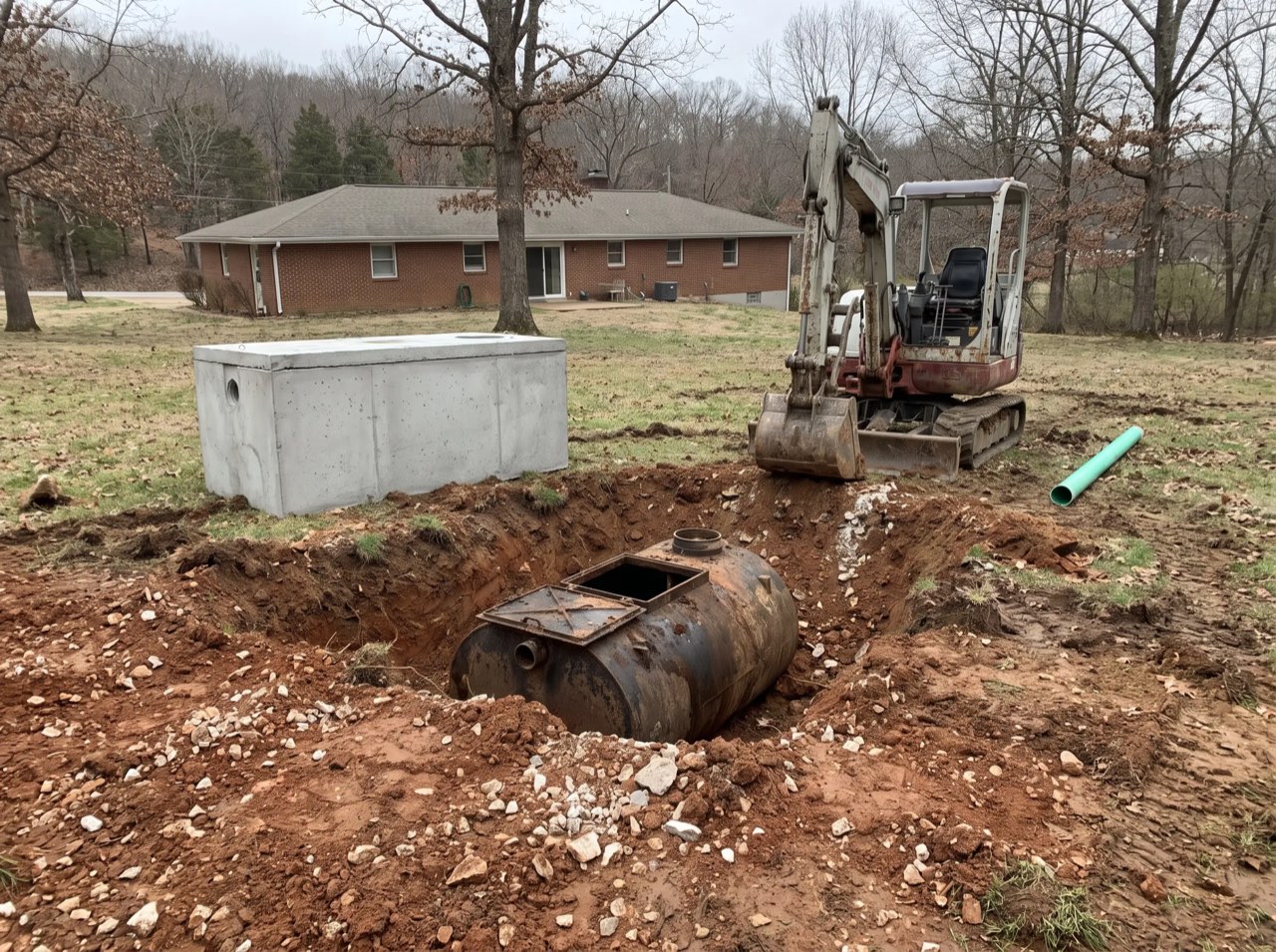
Signs a septic system is failing
- Sewage backs up into the lowest drain in the house.
- Every drain in the house is slow at the same time.
- The ground over the drain field is wet or spongy.
- You smell sewage in the yard.
- One strip of grass is much greener than the rest.
One slow drain is usually a clog in the house plumbing. Several of these signs together usually mean the tank or the drain field has a problem.
What to do right now
- Use less water. Every shower and load of laundry goes to a system that cannot take it.
- Stay off the area. Do not drive, park, or dig over the tank or the field.
- Keep people and pets away from standing water in the yard. It is sewage.
- Have the tank pumped if sewage is backing up into the house. That buys time, and the pumper can tell you what they see.
- Call us. The steps before a replacement take time, so it helps to start them early.
How often should a tank be pumped?
The EPA says household septic tanks are typically pumped every three to five years, and the system should be inspected at least every three years. A tank that goes much longer than that can send solids into the drain field and clog it.
Repair or replace?
Not every failure means a new system. Some problems are a single part:
- A crushed or separated pipe between the house and the tank.
- A broken distribution box or drop box.
- A failed pump or float in a pressure system.
- A clogged outlet or filter at the tank.
Those can be repaired. A drain field that has stopped absorbing water across its whole area is different. The soil has clogged, and it usually cannot be brought back. That field has to be replaced.
A cracked or collapsing tank also has to be replaced. Old steel tanks rust through, and some older concrete tanks break down at the top.
Why the system type may change
A replacement is permitted like a new system. The soil is evaluated, and the system is designed for what the yard can handle today. Rules have changed since many older systems went in, so the replacement is often not a copy of the original.
The new field usually needs fresh ground, away from the old one. It also has to meet today's state setbacks, including 100 feet from a private well and 10 feet from a property line. On a small or sloped lot, there may not be room for another conventional field. Then the design may call for a low pressure pipe system or a drip system, which fit where a conventional field will not.
J1S is licensed by the State of Missouri as an advanced septic installer, so we can build either kind. See all the systems we install.
How a replacement goes
- Find the problem. We look at the tank, the lines, and the field to see what failed.
- Soil evaluation. A soil evaluator tests the yard and reports what it can support.
- Design and permit. The plan is drawn and approved before any digging.
- Installation. The new tank or field goes in. The old tank is pumped and then removed or filled, as the permit requires.
- Inspection. The system is inspected before it is covered.
- Backfill and grading. The yard is graded so rain runs away from the system.
The yard will be disturbed where the new system goes. We shape it and leave it ready for seed. Rock is common here, and J1S owns its hydraulic hammer for breaking rock when a tank hole hits it.
What affects the cost
The system type is the biggest factor. A conventional gravity field costs the least. A system with a pump, controls, and an engineered design costs more. Rock, tree clearing, a long run from the house, and tight access for equipment add to it.
We quote from the approved design and a look at your yard. If you are still at the beginning, we can explain what each step involves before you spend anything.
Where we replace septic systems
J1S is based in Festus. We replace septic systems in Jefferson County, Ste. Genevieve County, St. Louis County, and nearby counties. In Ste. Genevieve County that includes Ste. Genevieve, Bloomsdale, St. Mary, and the rural lots between them. Send your address and we will confirm the permit requirements for your property.
Common questions
Septic replacement
How do I know my septic system has failed?
The common signs are sewage backing up into the lowest drain in the house, slow drains everywhere at once, wet or spongy ground over the drain field, a sewage smell outside, or unusually green grass in one strip of the yard. One slow drain is usually a clog. Several of these together usually point to the tank or the field.
Can a failed drain field be repaired instead of replaced?
Sometimes. A crushed pipe, a broken distribution box, a failed pump, or a clogged outlet can be repaired. A drain field that has stopped absorbing water across its whole area usually cannot be brought back and has to be replaced. The first step is finding out which of those you have.
Will pumping the tank fix it?
Pumping empties the tank and can buy you some time. It does not fix a drain field that no longer absorbs water. If the yard is wet again or the drains slow down again shortly after pumping, the field is the problem.
Why can the new system not go where the old one was?
Soil that has taken wastewater for decades is often the reason the system failed. A replacement usually needs fresh soil, so it goes in a different part of the yard. If there is not enough suitable ground, the replacement may need to be a different type of system that fits a smaller or more difficult area.
Do I need a permit to replace a septic system?
Yes, in most cases. A replacement goes through the same steps as a new system: a soil evaluation, a plan, a permit, and an inspection before the system is covered. Some counties also set conditions on replacing only the tank. We confirm what applies to your address before pricing the work.
How long does a replacement take?
The digging and installation usually take a few days. The soil evaluation, the design, and the permit take longer, and they have to come first. If your system has failed, call early so those steps can start.
Tell us what you are seeing.
A backup, a wet yard, or a smell. Send your address and what is happening, and we will tell you what the next step is.
Request a replacement quote Call (636) 331-5757