
Jefferson, Ste. Genevieve & St. Louis counties
Drip septic systems for difficult lots.
A drip system spreads treated wastewater through small tubing laid a few inches under the lawn. The tubing bends around trees and follows a slope, so it fits yards where trenches will not. Missouri requires an advanced installer for it, and J1S is licensed as one.
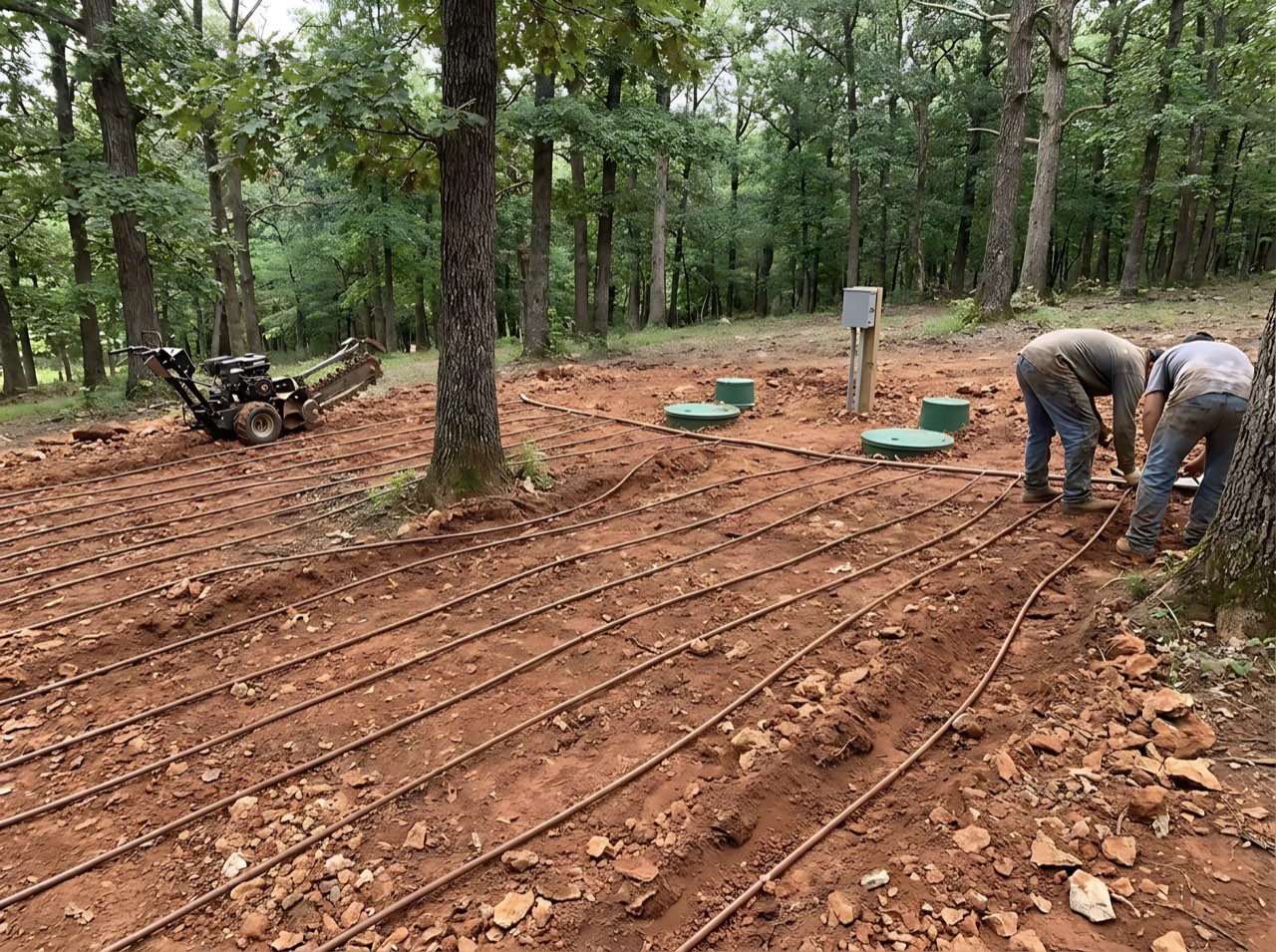
What a drip system is
A drip system uses the same idea as drip irrigation in a garden. Flexible tubing with small emitters is laid in a grid a few inches below the surface. A pump sends treated wastewater through the tubing in small doses, many times a day.
Each emitter releases a little water into the root zone of the lawn. The upper soil and the roots finish the treatment. Because the doses are small and spread out, the soil is never flooded.
When a lot needs drip
- Very shallow soil. The tubing sits near the surface, so it uses the soil a deep trench would dig through.
- Trees you want to keep. Tubing can curve between trees where straight trenches would mean clearing them.
- Steep or uneven ground. Tubing follows the contour of a hillside.
- A small or odd-shaped lot. The field can be fitted into the space that is left.
As with every septic system, the soil evaluation and the designer decide. If your plan specifies drip, the site ruled out the simpler options.
The parts of a drip system
| Part | What it does |
|---|---|
| Septic tank | Settles the solids |
| Treatment unit | Cleans the wastewater further so it will not clog the emitters |
| Pump tank | Holds the treated water between doses |
| Pump and filters | Send each dose out and screen out fine particles |
| Controls and alarm | Time the doses and warn you of a problem |
| Drip tubing | Spreads the water through the field |
Most drip systems include a treatment unit ahead of the tubing. The emitters are small, and cleaner water keeps them working. Your design shows which unit is specified.
Design and permits
A drip system is engineered for the site. The designer sets the size of the field, the tubing spacing, and the dosing schedule from your soil report and the size of your home. The permit is issued from that design.
Missouri allows only installers licensed as advanced to install the systems it lists as advanced, and drip is one of them. J1S holds the advanced license. See septic system installation for what that covers.
How we install it
- Layout. The tanks and field are staked from the plan. Trees to keep are marked.
- Tanks and treatment unit. Each is set level on a firm base.
- Tubing. The tubing is placed at a shallow, even depth along the contour, with as little disturbance to the yard as the site allows.
- Pump, filters, and controls. These are installed and wired.
- Testing. The system is run and checked for even flow and leaks.
- Inspection and cover. The system is inspected, and the yard is graded and left ready for seed.
Living with a drip system
- Keep up with service. Filters, tubing, and the treatment unit need regular attention. Many permits require a service agreement.
- Keep it in grass. Mow it like the rest of the lawn. Do not dig, till, or plant trees over it.
- Keep vehicles off. The tubing is only a few inches down.
- Answer the alarm. Use less water and call for service.
- Protect it in winter. Leave the grass cover in place and do not pack down snow over the field.
How often is drip serviced?
Plan on an inspection about once a year. The EPA says septic systems with pumps, float switches, or mechanical parts should be inspected generally once a year, where a gravity system is inspected at least every three years.
Your permit or the maker of the treatment unit may set a shorter interval. Follow whichever is stricter.
Drip or another type?
If your soil is deep and drains well, a conventional gravity system is simpler and costs less to own. If the soil is shallow but the lot is open, a low pressure pipe system may do the job with less equipment. If an old system has failed, start with septic replacement.
J1S is based in Festus and installs drip systems in Jefferson County, Ste. Genevieve County, St. Louis County, and nearby counties. In Ste. Genevieve County that includes Ste. Genevieve, Bloomsdale, St. Mary, and the rural lots between them.
Common questions
Drip systems
What is a drip septic system?
It is a septic system that spreads wastewater through flexible tubing with small built-in emitters, laid in a grid a few inches below the ground. A pump sends the water out in small timed doses, and the soil and grass roots finish treating it.
Why would my lot need a drip system?
Usually because the soil is very shallow, the lot is wooded or oddly shaped, or the ground is steep. Drip tubing sits shallow and can curve around trees and along slopes, so it can use ground that trenches cannot.
Is a drip system the same as a drop box system?
No, although the names sound alike. A drop box system is a gravity system with trenches stepped down a slope and no pump. A drip system uses a pump and small tubing. They suit different sites, and only the drip system needs an advanced installer.
What maintenance does a drip system need?
It needs regular service. The filters are cleaned, the tubing is flushed, and the pump, controls, and any treatment unit are checked. Many permits require a service agreement for the life of the system, so ask about that when you plan the budget.
Can I plant or build over the drip field?
Grass is the right cover. The tubing is only a few inches down, so do not dig, till, drive, or build on the area, and do not plant trees or a vegetable garden over it.
Is a drip system more expensive?
Yes. It has the most equipment of the common systems: usually a treatment unit, a pump tank, filters, controls, and the tubing field, plus an engineered design. Its advantage is that it can make a difficult lot buildable.
Send us your soil report.
If your designer has specified drip, send the plan and your address. If you are still deciding whether a lot can be built on, tell us, and we will explain the steps.
Request a drip system quote Call (636) 331-5757