
Gravel for the driveway. Topsoil and fill for the rest.
Screened topsoil, fill, crushed stone, gravel, and rip rap — delivered to your job site or driveway across Jefferson County and the St. Louis metro. Delivery only. Call for pricing and availability.
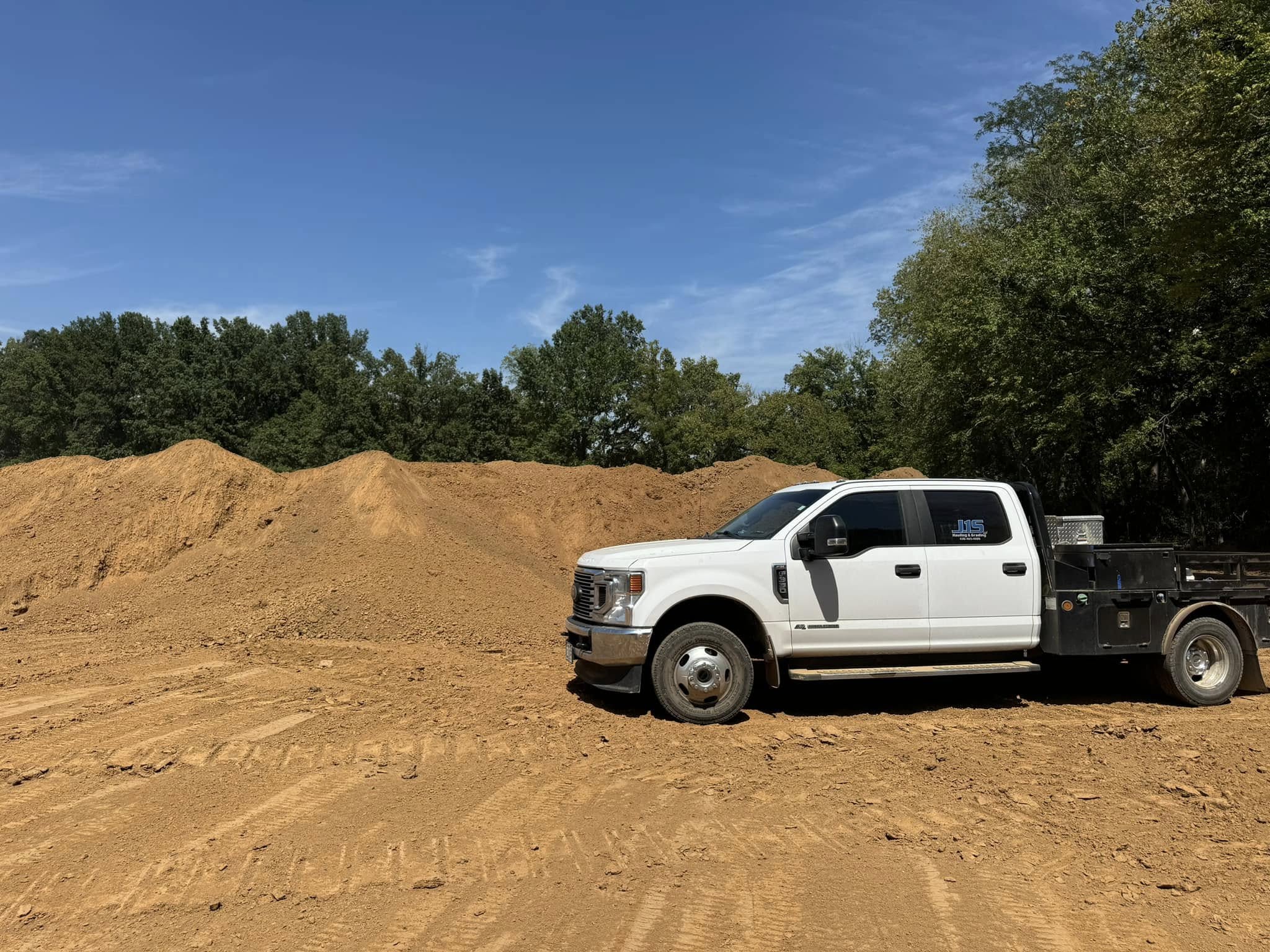 Delivered to Your Site
Choosing stone, topsoil,
or fill for the job.
Start with your job, not the material name. Every material does one thing well — and other things poorly. Match the two before you order.
Building or fixing a driveway
A driveway done right has two layers: a compacted base that doesn't move, then a surface stone that drains and stays put under tires.
Managing drainage or standing water
French drains, drainage swales, and downspout discharge all need washed, fines-free stone so water can move freely through the voids.
Filling, raising grade, or backfill
Structural fill compacts solid under load. Garden areas need organic content. Foundation work needs different material than lawn prep.
Patio, walkway, or landscape work
Pavers need a setting bed that levels flat and doesn't migrate. Decorative stone areas need something that drains well and looks clean.
Full material list with specs below ↓
Materials for every
stage of the job.
We stock what our crews use — screened right, graded right, available in the quantities you need. Call or text for current pricing and availability.
Screened Topsoil ½" screened · Fine organic By the Ton
Dark, fertile topsoil screened through ½" mesh — minimal stones, no clay clumps. Organic content supports immediate seed germination without amendment. Double-screened means what you get is clean and ready to spread.
Screened Topsoil specs, coverage & delivery → Guide: how much topsoil do I need? →- Lawn establishment & overseeding
- Garden beds & raised planters
- Grading finish & low spot repair
- Erosion control seeding prep
Fill Dirt Clay-loam · Unscreened By the Ton
Clean clay-loam fill — no organics, no topsoil, no debris. Compacts well with mechanical equipment and holds its grade under structural loads. This is what goes under foundations, slabs, and paved surfaces.
Fill Dirt specs, coverage & delivery → Guide: how much fill dirt do I need? →- Foundation & basement backfill
- Raising elevation & filling low spots
- Embankment & building pad construction
- Sub-base under concrete & asphalt
Crusher Run ¾" minus · Stone fines By the Ton
Angular crushed stone from ¾-inch pieces down to fines. The blend compacts into a dense base when placed over suitable ground in appropriate lifts. Drainage, preparation, and compaction determine how it performs.
Crusher Run specs, coverage & delivery → Guide: what is crusher run? →- Driveway base & sub-base (4–6" compacted)
- Parking lot foundation
- Equipment pads & staging areas
- Walking paths & low-traffic access roads
#57 Limestone ¾" angular · ASTM #57 By the Ton
Three-quarter inch washed angular limestone — the most-ordered material we stock. Sharp edges interlock and stay put under traffic without packing solid. Water moves freely through the stone-to-stone voids, useful for both drainage and surface applications.
#57 Limestone specs, coverage & delivery → Guide: #57 vs #4 stone →- Driveway surface & parking areas
- French drains & drainage beds
- Around foundations & downspouts
- Septic system cover stone
Mason Sand Fine washed · ASTM C144 By the Ton
Fine washed sand listed for mortar and masonry work. Match the material to the project specification before using it for bedding, backfill, or another application.
Mason Sand specs, coverage & delivery →- Mortar and masonry mix aggregate
- Other uses where the specified sand grading matches
River Rock 1"–3" smooth · Rounded By the Ton
Naturally tumbled stone in mixed 1–3" sizes — smooth, round, and water-worn. Heavy enough to stay in drainage swales under flow, light enough to move by hand. Looks good wet or dry, the standard for visible drainage features and landscape borders.
River Rock specs, coverage & delivery →- Landscape beds & borders
- Dry creek beds & drainage swales
- Around downspouts & catch basins
- Decorative mulch alternative
Rip Rap 6"–18" angular · Heavy By the Ton
Large angular stone — typically 6 to 18 inches — placed by machine where erosion forces are too strong for smaller material. The mass and angular contact points resist hydraulic force. Often engineer-specified for creek banks and culvert outfalls.
Rip Rap specs, coverage & delivery →- Creek & ditch bank stabilization
- Culvert inlet & outlet protection
- Steep slope erosion control
- Retaining wall drainage backing
Pea Gravel ⅜" smooth · Rounded By the Ton
Small, smooth, naturally rounded stone — typically ⅜" diameter. Drains fast, stays cool underfoot, and has a visual cleanliness that crusher run doesn't. Comfortable for bare feet and pet paws on warm days.
Pea Gravel specs, coverage & delivery →- Dog runs & pet areas
- Patio surfaces & casual pathing
- Driveway topping layer over packed base
- Decorative groundcover in beds
#4 Clean Stone 1½" angular · ASTM #4 By the Ton
Washed 1½" crushed stone with no fines — just clean angular rock. The larger stone size and absence of fines means the highest drainage rate we carry. Used where #57 would migrate under pressure or where drainage volume demands more open void space.
#4 Clean Stone specs, coverage & delivery → Guide: #57 vs #4 stone →- French drain & dry well fill
- Leach field cover stone
- Large-diameter pipe bedding
- High-volume drainage trenches
Bank Run Gravel Mixed ¾"–fines · As-dug By the Ton
Unprocessed pit-run material as it comes out of the bank — a natural mix of sand, small stones, and fines in varying proportions. The most economical sub-base and fill we carry. Performs well when precise drainage specification isn't required and you need volume at price.
Bank Run Gravel specs, coverage & delivery →- Economy driveway base
- Backfill around drainage pipe
- Low-traffic road maintenance
- Utility trench backfill
Limestone Screenings ¼" minus · Dust fines By the Ton
Fine crushed limestone, from dust to ¼-inch chips. Screenings can compact into a firm path surface when the base and drainage are prepared for the site. They are not drainage stone or a universal paver bedding material.
Limestone Screenings specs, coverage & delivery → Guide: what is limestone screenings? →- Compacted garden and walking paths
- Landscape leveling where specified
- Fine aggregate surfacing where specified
Boulders 50–400+ lbs · Natural limestone By the Ton
Natural limestone boulders, individually placed by hand or machine depending on size. No two are the same — the irregular shape and weathered surface are the point. Ranges from manageable accent stones around 50 lbs to statement pieces that need a machine to position.
Boulders specs, coverage & delivery →- Landscape accent stones & focal points
- Natural retaining walls & slope stabilization
- Dry stream beds & water feature edging
- Property edge markers & driveway borders
Pricing not listed — availability and pricing vary by season and quantity. Call (636) 331-5757 or request delivery.
How many loads
do you need?
Enter your area or total quantity and we'll calculate how many quad-axle truck loads it takes. Load estimates below use a 35-ton planning example. Dispatch confirms the actual truck, payload, and any material allowance before you order. Building a driveway? The driveway gravel calculator sizes the base and surface layers separately.
Truck Load Estimator
Pickup dump to quad-axle — we match the truck to the load
Estimates based on standard material densities. Add 10–15% for compaction and waste.
Every load delivered.
We run delivery routes with our tri-axle and tandem dump trucks across Jefferson County and the St. Louis metro — to job sites, driveways, and residential properties.
For large orders, we can stage material directly on-site and coordinate with your crew. Call dispatch to talk through quantities and logistics before you commit.
Material quantities,
truck access, and delivery.
Questions we hear from homeowners, landscapers, and contractors figuring out what they need and how to get it on-site.
Do you deliver to residential addresses?
Yes — we deliver to driveways, yards, and residential job sites throughout Jefferson County and the surrounding metro. We'll need reasonable access for a tri-axle, so give us a heads-up if the approach is tight or if you have a low-clearance entrance. For small residential orders where a full tri-axle isn't practical, call and we'll figure out the right truck size for your driveway.
What's the minimum order for delivery?
Send the material, quantity, and address to dispatch. We confirm the minimum order, available truck, and transport charge for that request before booking.
Can you deliver to a residential driveway or backyard?
Yes — we deliver to driveways, yards, and residential job sites throughout Jefferson County and the metro. We'll need reasonable vehicle access for a tri-axle, so give us a heads-up if your approach is tight or has a low overhang. For small residential orders, call and we'll match the right truck size to your site.
Is material sold by the yard or by the ton? What's the difference?
A cubic yard measures volume; a ton measures weight. Tell us which quantity you have, and confirm the sales unit on the quote before comparing totals. Calculator densities are estimates; moisture and the supplied material affect the conversion.
How thick should I put down crusher run for a driveway?
For a new driveway, 4–6 inches compacted is the standard. Start with 4" if you have a solid sub-base, 6" if you're building over soft or disturbed ground. Compact in two layers: a 3" base lift, then a 2–3" top lift. Compacting one thick layer all at once doesn't consolidate properly from the bottom. If you're adding crusher run on top of an existing driveway to fix soft spots, 3–4" compacted is usually enough.
How much material do I need to add 10%?
The calculator gives you the base number. For most projects, add 10–15% to that for material lost to compaction, uneven spreading, and edge waste. So if the calculator says 10 tons, order 11–11.5 tons. For trench backfill where compaction is significant (fill dirt or crusher run), go closer to 15–20% over. Better to have a small pile left over than to come up short and pay a second delivery charge.
What's the difference between #57 limestone and #4 clean stone?
#57 is ¾" — smaller, more commonly available, and works for most drainage and driveway applications. #4 clean stone is 1½" — larger with bigger voids, so it drains significantly faster. Use #57 for driveways, French drains around foundations, and septic cover. Use #4 where you need high drainage volume: leach fields, dry wells, and large-diameter pipe bedding. #4 also handles freeze-thaw cycles better in drainage applications because the larger void space doesn't frost-heave the same way.
Can I order a mix of materials in one delivery?
Often yes, depending on what fits in the truck and how close the materials load to the same density. A split load of crusher run and #57 works fine. A split of topsoil and rip rap — less ideal. Call and describe what you need and we'll tell you if it makes sense as one run or two.
Do you do same-day or next-day delivery?
We often do. Call dispatch at (636) 331-5757 and tell us where you are and what you need. Jefferson County deliveries have the best shot at same-day. Further out into the metro, we'll give you an honest read on the schedule. We run 7 days, so weekend deliveries are on the table.
Can I use topsoil to raise my grade?
For a few inches of elevation change around a lawn or garden, yes — topsoil works fine as a finish raise. But for anything structural, under a slab, or for raising more than 6 inches, use fill dirt first and cap it with topsoil at the end. Fill dirt compacts; topsoil doesn't. Building 12 inches of grade with straight topsoil will settle unevenly and cause problems under any hardscape you put on top of it.
Tell us what you need
and when you need it.
Call dispatch and we'll see what we can do. We run 7 days and often have same-day or next-day availability for local deliveries.