
Jefferson, Ste. Genevieve & St. Louis counties
Septic drain field installation.
The drain field is the part of a septic system that does the treating. It is also called a leach field, a lateral field, or an absorption field. J1S digs the trenches, places the stone and pipe, and backfills with the right dirt, as a licensed advanced septic installer.
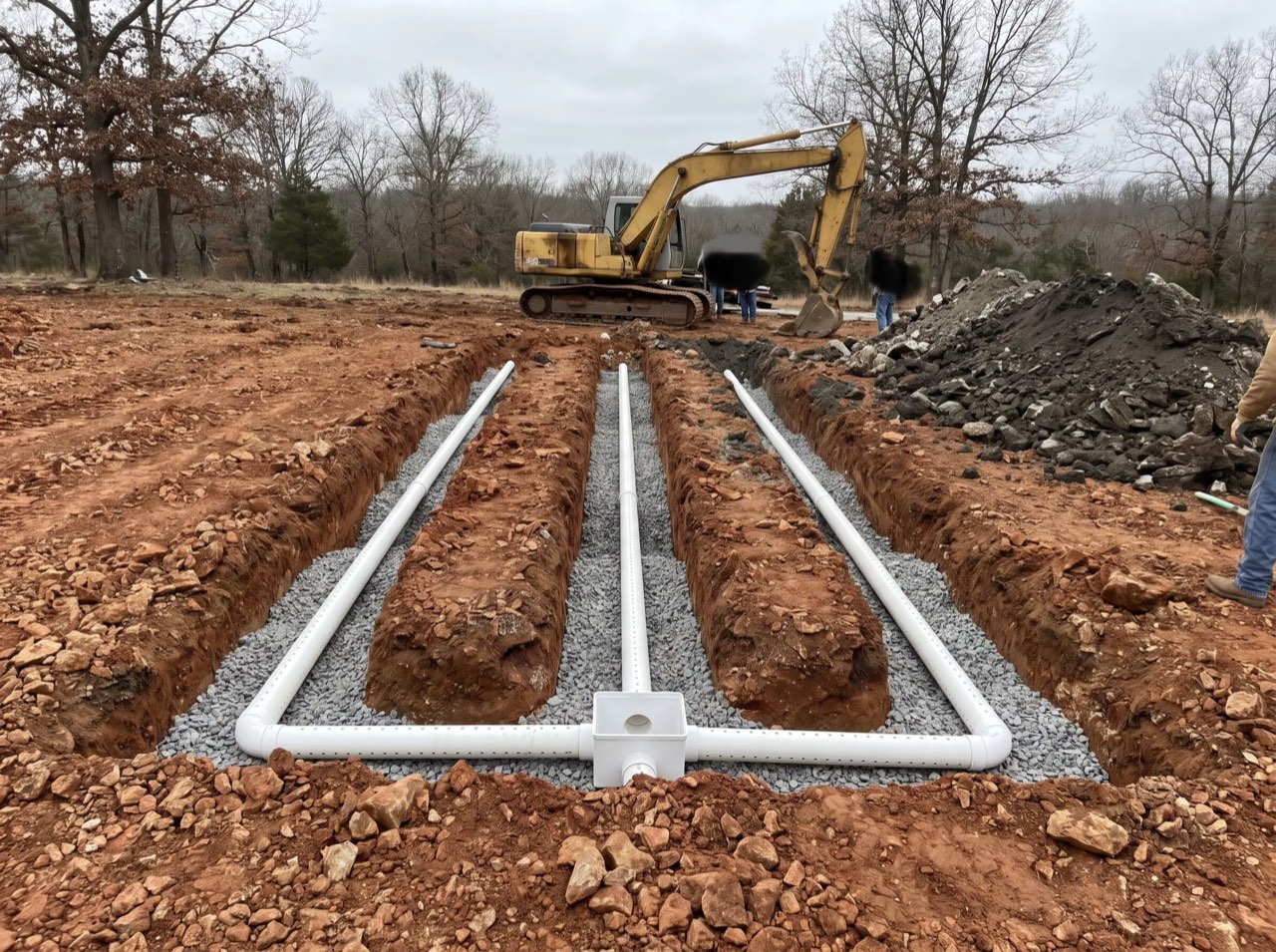
What is a drain field?
A drain field is a set of trenches that spreads the liquid from a septic tank into the soil, where it is treated. Under Missouri's construction standards, a standard trench is 18 to 36 inches wide, with its bottom 18 to 30 inches below the finished grade.
Solids stay in the tank. The liquid flows to the field through a distribution box or drop boxes, seeps out of perforated pipe into a bed of stone, and soaks into the soil below. The soil does the final cleaning, which is why the soil decides whether a system works.
How big is a drain field?
Missouri sizes a standard drain field by bedrooms and by how fast the soil absorbs water. The trench bottom area runs from 150 square feet per bedroom in fast soil to 600 square feet per bedroom in slow soil.
| Soil absorption rate | Trench area per bedroom | Three-bedroom house |
|---|---|---|
| 10 minutes per inch or faster | 150 square feet | 450 square feet |
| 11 to 30 minutes per inch | 200 square feet | 600 square feet |
| 31 to 45 minutes per inch | 265 square feet | 795 square feet |
| 46 to 60 minutes per inch | 300 square feet | 900 square feet |
| 61 to 120 minutes per inch | 600 square feet | 1,800 square feet |
That is trench bottom area, not yard area. Trenches are spaced at least three times their width apart and no closer than 5 feet on center, and no trench runs longer than 100 feet without approval. The yard also needs room set aside for a replacement field. Your soil evaluation and the approved design give the real numbers for your lot.
What stone goes in a drain field?
Missouri's standards call for clean gravel or crushed stone sized between 1½ and 3 inches, at least 12 inches deep in the trench. At least 6 inches sits below the pipe and 2 inches over it.
Crushed limestone has to be washed and at least 1½ inches. Dust and fines clog the soil, so driveway gravel and crusher run do not belong in a drain field. The stone is covered with untreated building paper, drainage fabric, or another approved barrier before any dirt goes back, so soil does not wash down into it.
Gravel or chambers?
Some designs use plastic chambers or wrapped gravelless pipe in place of stone. Missouri's standards allow both and give each a trench width it counts as. We build what the approved plan specifies.
What dirt goes over a drain field?
In most soil, the dirt that came out of the trench goes back in over the barrier. In slow soil, where water takes more than 45 minutes to drop an inch, Missouri's standards call for sand, loamy sand, or sandy loam as backfill when it is available, capped with 2 to 4 inches of loamy soil.
The backfill is left loose and is not packed with equipment. The surface is shaped so rain runs off and no low spot holds water, and grass is started as soon as possible.
Fill dirt and drain fields
Some sites need fill to build up enough soil before a field can go in. Missouri's standards treat that as part of the design, with rules for the dirt and for how it is placed:
- Sandy texture. The fill should be sandy, with no more than 20 percent clay.
- Dry work only. Fill is not hauled or worked wet, and the ground is loosened first while it is dry.
- Tilled in layers. Each layer is tilled into the one below, so there is no hard boundary between the fill and the natural soil.
- No traffic. Equipment stays off the loosened ground.
- Shaped and seeded. The site is graded to shed water, and turf grass is established after the system goes in.
Ordinary fill dirt is clay loam, sold for raising grade and backfilling foundations. It is not the sandy fill a drain field design specifies. Tell us what your design calls for and we will quote the material with the job. For regrowing grass over a finished field, screened topsoil is the right cover.
Repairing a drain field
Wet ground over the field, a sewage smell in the yard, and slow drains through the whole house are the usual signs of trouble. A single broken part can often be repaired. A field that has stopped absorbing water has to be replaced, and the new one usually goes in fresh ground.
Our septic replacement page covers the warning signs and what to do first. If the yard has no room for another standard field, the design may call for a low pressure pipe system or a drip system.
How we build a drain field
- Layout. The trenches are staked from the approved plan, along the contour of the ground. Buried utilities are located first.
- Trenches. Each trench is dug to the plan depth with a level bottom.
- Stone and pipe. Washed stone, perforated pipe, and more stone go in to the depths on the plan. Chambers go in where the plan calls for them.
- Barrier. The stone is covered before backfill.
- Inspection. The field is inspected before it is covered.
- Backfill and grade. The right dirt goes back loose, and the surface is shaped to shed water and left ready for seed.
Rock is common here. J1S owns its hydraulic hammer for breaking rock when a trench hits it.
Where we install drain fields
J1S is based in Festus and installs and replaces drain fields in Jefferson County, Ste. Genevieve County, St. Louis County, and nearby counties. In Ste. Genevieve County that includes Ste. Genevieve, Bloomsdale, St. Mary, and the rural lots between them. See all the septic systems we install.
Common questions
Drain fields
Is a drain field the same as a leach field?
Yes. Drain field, leach field, lateral field, and absorption field all mean the same thing: the trenches where liquid from the septic tank soaks into the soil. Missouri's standards call it a soil absorption system.
How long does a drain field last?
It depends on the soil, the size of the field, how much water the house uses, and whether the tank is pumped on schedule. A field fails early when solids reach it from a tank that was not pumped, or when vehicles pack the soil over it.
Can I drive or park on a drain field?
No. Weight packs the soil and can crush the pipe, and packed soil stops absorbing water. Keep vehicles, trailers, sheds, and livestock off the field.
Can I add dirt on top of my drain field?
A thin layer of topsoil to fill settled spots and regrow grass is normal. Adding deep fill is different. It cuts off air to the soil and can put the field out of line with its permit, so ask the permitting office before raising the grade over a field.
What can I plant over a drain field?
Grass. Missouri's standards call for turf grass cover as soon as possible after the system goes in. Keep trees and shrubs away, because roots find the pipes.
Can a drain field be repaired without replacing it?
Sometimes. A crushed pipe, a broken distribution box, or a failed drop box can be repaired. A field that no longer absorbs water across its whole area has to be replaced, usually in a different part of the yard.
Send us your soil report.
If you have a plan, send it with your address. If your field is failing and you have nothing yet, tell us what you are seeing and we will explain what comes first.
Request a drain field quote Call (636) 331-5757