
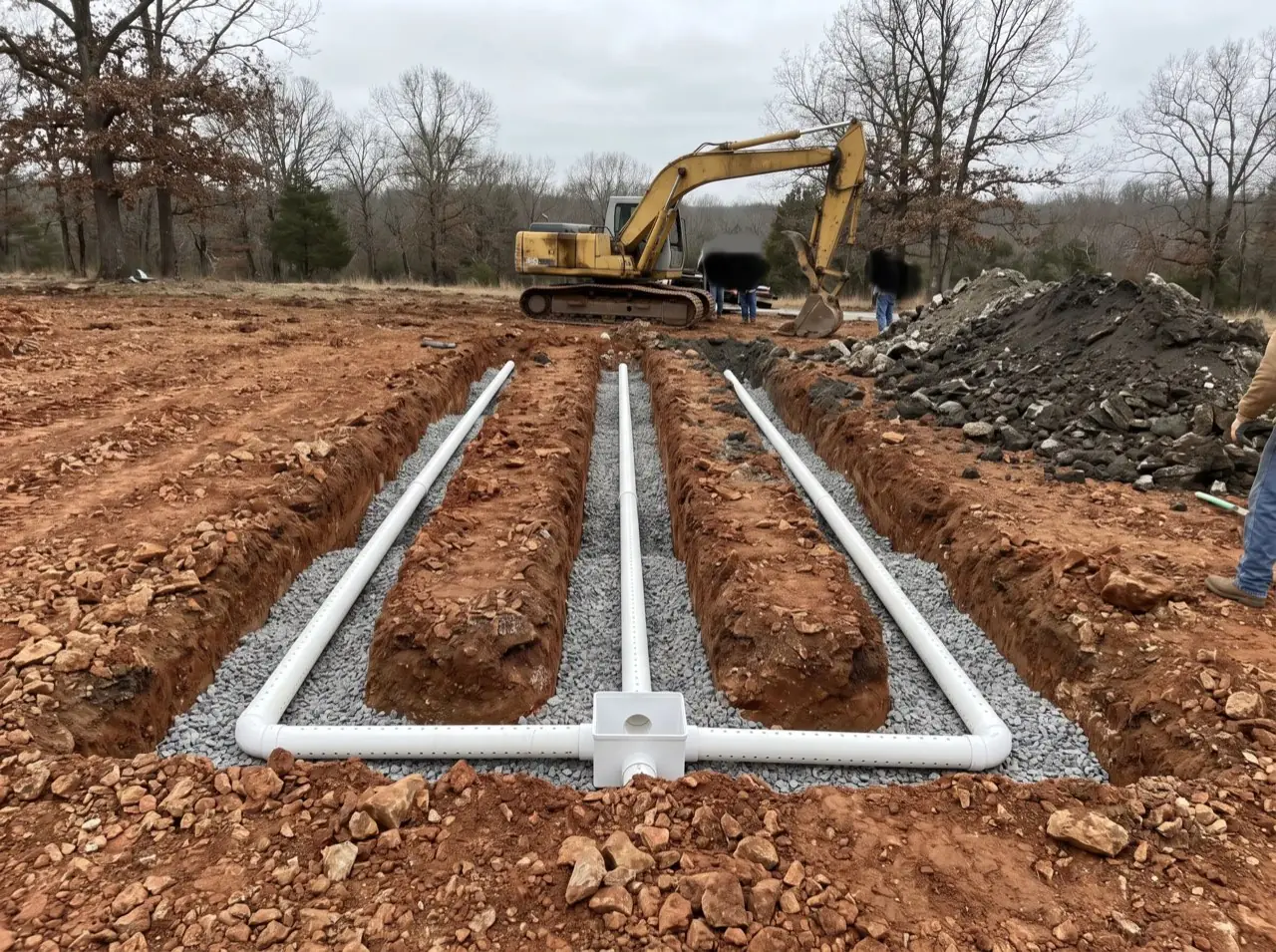
Can a failed drain field be repaired?
Sometimes. A crushed pipe, a broken distribution box, a failed pump, or a clogged outlet can be repaired. A drain field whose soil has clogged usually cannot be brought back, and a replacement field has to meet today's setbacks, including 100 feet from a private well and 10 feet from a property line.
| What failed | Usual fix | Permit steps |
|---|---|---|
| Pipe between the house and the tank | Repair the pipe | Ask the permitting office |
| Distribution box | Replace the box | Ask the permitting office |
| Pump or float switch | Replace the part | Ask the permitting office |
| Clogged tank outlet | Clear the outlet | Ask the permitting office |
| Soil in the drain field | Replace the field | Soil evaluation, plan, permit, inspection |
Each county runs its own permitting, so confirm what a repair needs before work is priced.
What are the signs of septic failure?
The EPA lists these as signs of a failing system:
- Water and sewage backing up into the house from toilets, drains, and sinks.
- Bathtubs, showers, and sinks that drain very slowly.
- Gurgling sounds in the plumbing.
- Standing water or damp spots near or over the tank or the drain field.
- Sewage odors around the tank or the drain field.
- Bright green, spongy grass over the tank or the drain field, even in dry weather.
One slow drain is more likely a plumbing clog. Several of these at once, or wet ground over the field, point at the system.
Why does a drain field stop working?
The EPA says most systems malfunction because of inappropriate design or poor maintenance. When a tank is not pumped, solids can move out into the drain field and clog it.
Soil that has taken wastewater for decades often no longer absorbs the way it did. Extra water makes it worse. The EPA advises keeping roof drains, sump pumps, and other rainwater away from the drain field, because excess water slows or stops treatment.
Why not rebuild the old field?
Because the soil there is the problem. A replacement usually goes in fresh soil in a different part of the yard, and it is permitted like a new system: the soil is evaluated and the system is designed for what the yard can handle today. So the system type may change. A yard that held a gravity system years ago may need a low pressure pipe or drip system now, if the remaining soil is shallow or slow.
What does a replacement involve?
- Soil evaluation. A soil evaluator tests the yard and reports what it can support.
- Design and permit. The system is drawn for that soil, and the permit is issued from the plan. These take longer than the digging, and they have to come first.
- The old tank. It is pumped and then removed or filled, as the permit requires.
- The new field. Trench bottoms are kept level, and equipment stays off the field area so the soil is not compacted.
- Inspection. The system is inspected before it is covered.
Rock is common in Jefferson County. J1S owns its hydraulic hammer, so a tank hole that hits rock does not stop the job. See drain field replacement and septic system replacement for the full process.
How do you protect a drain field?
Do not park or drive on the drain field. Plant trees far enough away that roots cannot grow into the system. Keep rainwater drainage off it. Have the system inspected at least every three years, and expect the tank to need pumping every three to five. A system with a pump or other mechanical parts should be looked at about once a year.
What to send for a quote
Send with your request: the property address; what is happening and for how long; the number of bedrooms; when the tank was last pumped, if you know; any soil report or old system plan; and what the yard is like, including hills, rock, and wet spots.
You do not need a soil test or a plan yet. Send the address and J1S will confirm the permit requirements for the property.
Sources
- EPA, Resolving Septic System Malfunctions: signs and causes of failure.
- EPA, How to Care for Your Septic System: inspection, pumping, and drain field care.
- Missouri Code of State Regulations, 19 CSR 20-3: setbacks and construction standards.