
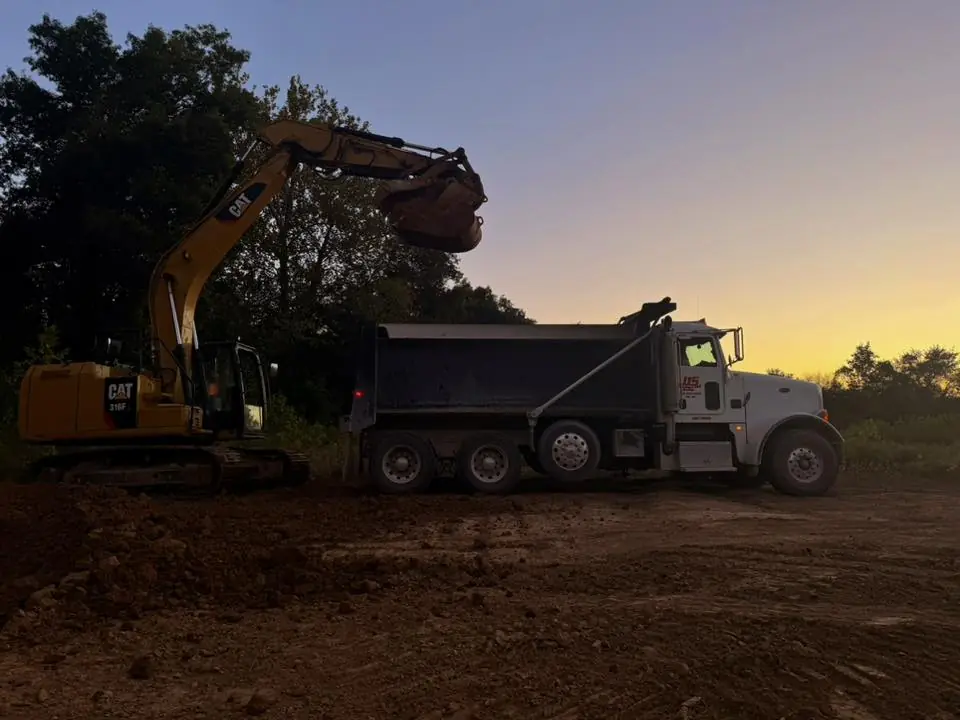
What is grading in construction?
Grading in construction is shaping the ground surface to planned elevations and slopes. Soil is cut from high areas and placed in low areas, then compacted, so the site sits at the right height for what will be built on it and sheds water toward a planned outlet. Most of the soil stays on the site.
Every graded surface has a job. A building pad has to be level and firm enough to carry a foundation, a driveway needs a side-to-side slope so rain runs off, and a yard has to fall away from the house. The grade is checked against the heights on the plan.
What does grading work include?
On a typical job the work runs in this order:
- Survey and stakes. The crew sets benchmarks and grade stakes from the plan, so every cut and fill has a target elevation.
- Strip the topsoil. Topsoil and organic material come off first. Good topsoil is stockpiled to go back on at the end.
- Cut and fill. Soil is moved from high ground to low ground until the site is close to its planned shape.
- Compact the subgrade. Fill is placed and compacted in layers, called lifts, so it does not settle later.
- Fine grade. The surface is brought to the plan elevations and checked against the stakes.
- Topsoil, seed, and erosion control. Lawn areas get topsoil back, then seed and straw or blanket to hold the soil until grass grows.
Common grading jobs include building pads, driveways, parking lots, subdivision lots, retention ponds, and correcting a yard that drains toward the house. The machines are dozers for moving bulk soil, motor graders for long flat surfaces, and skid steers for smaller residential work.
What is rough grade versus finish grade?
Rough grade gets the site close to its planned shape, usually within several inches. Finish grade is the final surface, set to tight tolerances and ready for what goes on it next: topsoil and seed, sod, concrete, or asphalt. Many contractors also name a fine grade step between the two.
| Rough grade | Finish grade | |
|---|---|---|
| Purpose | Move the bulk of the soil and set the general shape | Set the final surface and drainage |
| Accuracy | Within several inches of the plan | Fractions of an inch for slabs and paving |
| Equipment | Dozers and excavators | Motor graders and skid steers, checked with a laser or level |
| When | Early, before foundations and utilities | Last, after other earthwork and backfill are done |
| Next step | Construction, trenching, or fine grading | Topsoil and seed, sod, concrete, or asphalt |
The order matters. Finish grade done too early gets torn up by trucks, trenching, and settling backfill, and has to be done again. On a slab or paving job the tolerance matters even more, because the concrete or asphalt thickness depends on the subgrade being where the plan says. J1S runs machine control on its graders, and on a calibrated, controlled site it holds within plus or minus 0.05 feet, about 5/8 of an inch.
How much should ground slope from a house?
The International Residential Code requires the ground to fall at least 6 inches within the first 10 feet from the foundation. Where a lot line, wall, or slope makes that impossible, drains or swales have to carry the water away instead. Paved surfaces within 10 feet of the foundation must slope at least 2 percent away from the building.
The math: 6 inches of drop over 10 feet (120 inches) is about a 5 percent slope.
Your city or county adopts its own edition of the code and can amend it, so the local building department has the final word. Our post on lot grading and drainage before winter covers how to check an existing yard and the signs that it needs regrading.
Does grading need a permit?
In Missouri, construction that disturbs one acre or more needs a land disturbance permit from the Missouri Department of Natural Resources. Smaller sites need one too when they are part of a larger common plan of development or sale, such as a lot in a new subdivision. The main requirement of the permit is a stormwater pollution prevention plan, which spells out the erosion and sediment controls for the site.
Below that threshold the state permit does not apply. A city or county can still have its own grading, stormwater, or building permit rules. Ask the local office before work starts. Our post on erosion control in Jefferson County covers the controls that go with the permit. J1S pulls the permits its work requires.
Call 811 before grading. Missouri's underground facility law counts grading as excavation, so grading needs the same Missouri 811 notice as digging a trench. Cutting down a slope or a ditch line also reduces the soil cover over any line beneath it.
How is grading different from excavation?
Excavation removes soil to make a hole, trench, or other cavity, and the material usually leaves the area or goes back in as backfill. Grading reshapes the surface and mostly keeps the soil on site. A new house needs both: excavation for the footings and basement, then grading around it so the lot drains. Our post on grading versus excavation explains how each is scoped and priced.
What to send for a grading quote
Send with your request: the address; what will be built or what problem needs fixing; plans or a survey with elevations if you have them; photos after a rain for drainage work; roughly how much ground will be disturbed; and whether soil needs to come in or go out.
For price ranges by scope, see the land grading cost guide. J1S does grading and site preparation for building pads, driveways, and drainage across Jefferson County and the St. Louis metro.
Sources
- International Code Council, 2015 International Residential Code, Chapter 4 Foundations: Section R401.3 requires the grade to fall at least 6 inches within the first 10 feet, with drains or swales where barriers prevent it, and impervious surfaces within 10 feet to slope at least 2 percent away.
- Missouri Department of Natural Resources, Construction Land Disturbance Permits: a permit is required for construction disturbing one acre or more, or less when part of a larger common plan of development or sale, and its main requirement is a stormwater pollution prevention plan.
- Missouri Revised Statutes, Section 319.015: the definition of excavation under the underground facility law includes grading.
- Missouri Revised Statutes, Section 319.026: an excavator must notify the notification center before starting an excavation.
- OSHA, 29 CFR 1926.650, Scope, application, and definitions: an excavation is a man-made cut, cavity, trench, or depression in an earth surface formed by earth removal.