
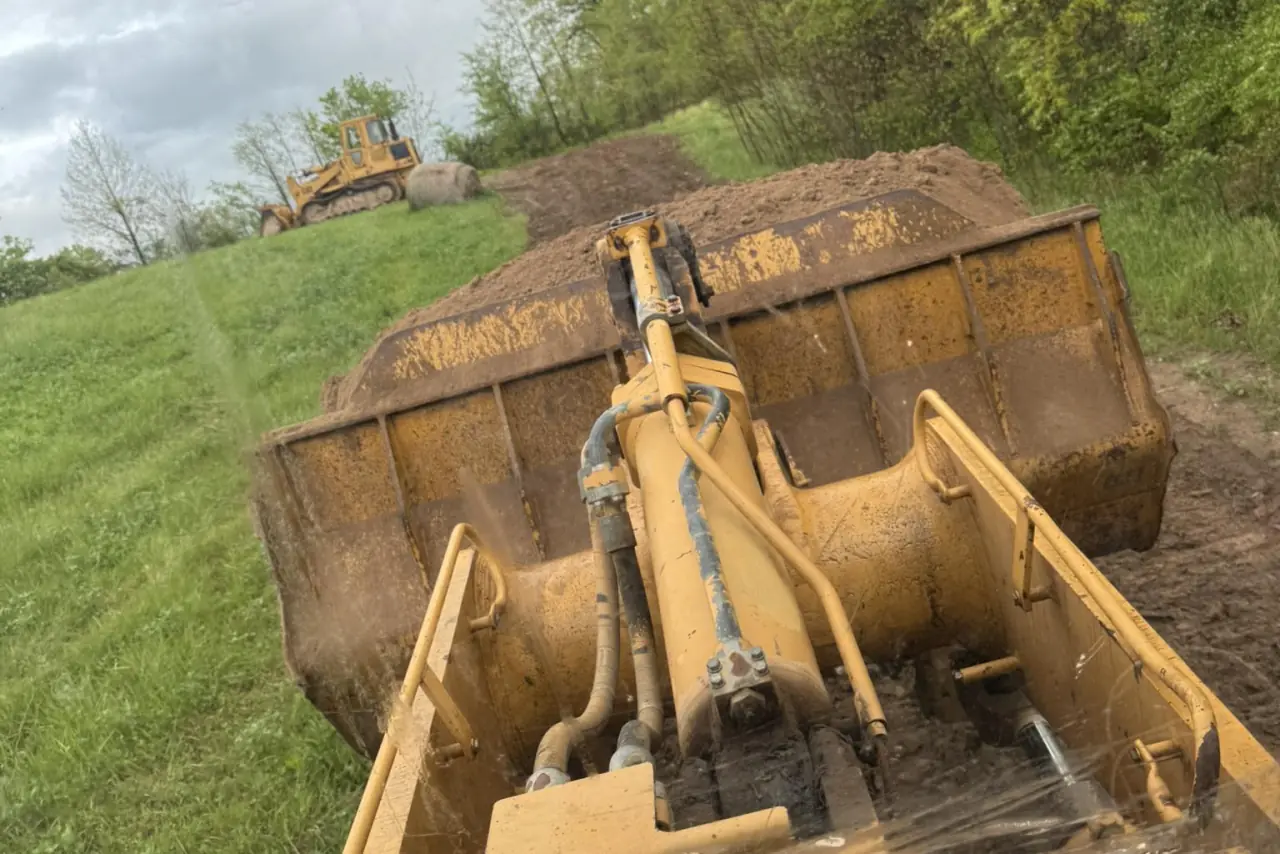
How does grading differ from excavation?
Excavation removes soil to create a hole or trench and is measured in cubic yards, while grading reshapes the surface and leaves the material on site. Grading is the precision step: reaching final grade typically takes 2 to 3 passes with a grader or skid steer, checked against set elevation points.
Which one does my project need?
| Project | Work needed | Why |
|---|---|---|
| New home site prep | Both | Dig the foundation, then shape the lot to drain away from the house |
| Driveway | Mostly grading | Soft topsoil or old fill may have to be dug out first |
| Yard holds water | Grading | Re-slope the surface toward a drain, swale, or storm sewer |
| Retaining wall | Excavation, then grading | Dig out behind the wall, then set the grade on both sides |
| Utility trench | Excavation | Dig, lay the line, backfill; grading is only cleanup |
See the utility trenching guide for trench work.
What is excavation?
Removing soil, rock, or fill from a set area to a set depth: a trench, a foundation cut, a pond. Something then fills that space, such as a footing, a pipe, or water. It is measured in cubic yards, and the dirt that comes out has to go somewhere: spread on site, trucked to a yard, or hauled to disposal. Typical machines are excavators, track loaders, mini excavators, and hydrovac trucks.
What is grading?
Shaping the ground surface to a target height and slope. Soil is cut from high spots and pushed into low ones, and it stays on the property. It is judged by whether the surface drains and sits at the right height, not by how much dirt moved. It usually runs in three stages:
- Rough grading: fast, bulk work to get close. Accurate to inches.
- Fine grading: more passes to get near the final height.
- Finish grading: the final surface for concrete, asphalt, seed, or sod, accurate to fractions of an inch and checked with a laser or grade stakes.
Typical machines are dozers, motor graders, and skid steers with a blade.
Where do they overlap?
Any site with a big change in height needs both. Dropping a lot 4 feet across 200 feet means hauling material out, which is excavation, before the surface can be graded. A foundation is the same: excavation makes the hole, and grading shapes the bottom and the ground around it.
That is why "site prep" on a quote is not enough. It should say how much material moves, where it goes, and what the final grade target is.
How is each one priced?
Both are priced by equipment time, at similar hourly rates. Bulk digging moves a lot of dirt per hour. Finish grading is slower on purpose: more passes, tighter tolerances, and repeated checks. A quote for "some grading" on a job that really needs dirt hauled off will change once the contractor counts the cubic yards that have to leave.
What should I tell the contractor?
Say what the ground looks like now, what it needs to look like, how much height changes from one end to the other, whether soil can stay or must leave, and what goes on the finished surface. For example: "the back half of my lot is 3 feet higher than the front, water is running toward the foundation, and I need to redirect it to the drainage easement at the east property line." That lets the contractor price the real job.
For prices, see the Missouri excavation cost guide and land grading costs. J1S does both, often with the same machines on the same job.
Common questions
Can I get one quote for both?
Yes. Most site prep projects involve both. J1S quotes the full scope after a site visit, breaking out the phases so you know what the excavation costs and what the grading costs, instead of a single number with undefined scope.
Why does grading sometimes cost more?
Precision. Rough excavation moves material quickly. Fine grading takes multiple passes, blade work, and checks with a laser or grade stakes at set points. The equipment time is similar, but the machine works slower by design and the work takes more skill.
Do I need separate contractors?
No. Most excavation contractors do both. One crew for both phases already knows the site, the soil, and where the material needs to go. Splitting the work between contractors is rarely faster and often causes problems at the handoff.
What does "final grade" mean?
Final grade is the finished surface height, ready for concrete, asphalt, seed, or sod. It is specified in fractions of an inch and checked against points set by the contractor or a surveyor. Getting from rough cut to final grade is typically 2 to 3 passes with a grader or a skid steer with a blade. "Final grade" in a quote means the contractor is responsible for reaching that precision, not just getting close.
Sources
- OSHA, 29 CFR 1926.650, Scope, application, and definitions: excavation is defined as a cut or depression formed by earth removal, and a trench as a narrow excavation deeper than it is wide.