
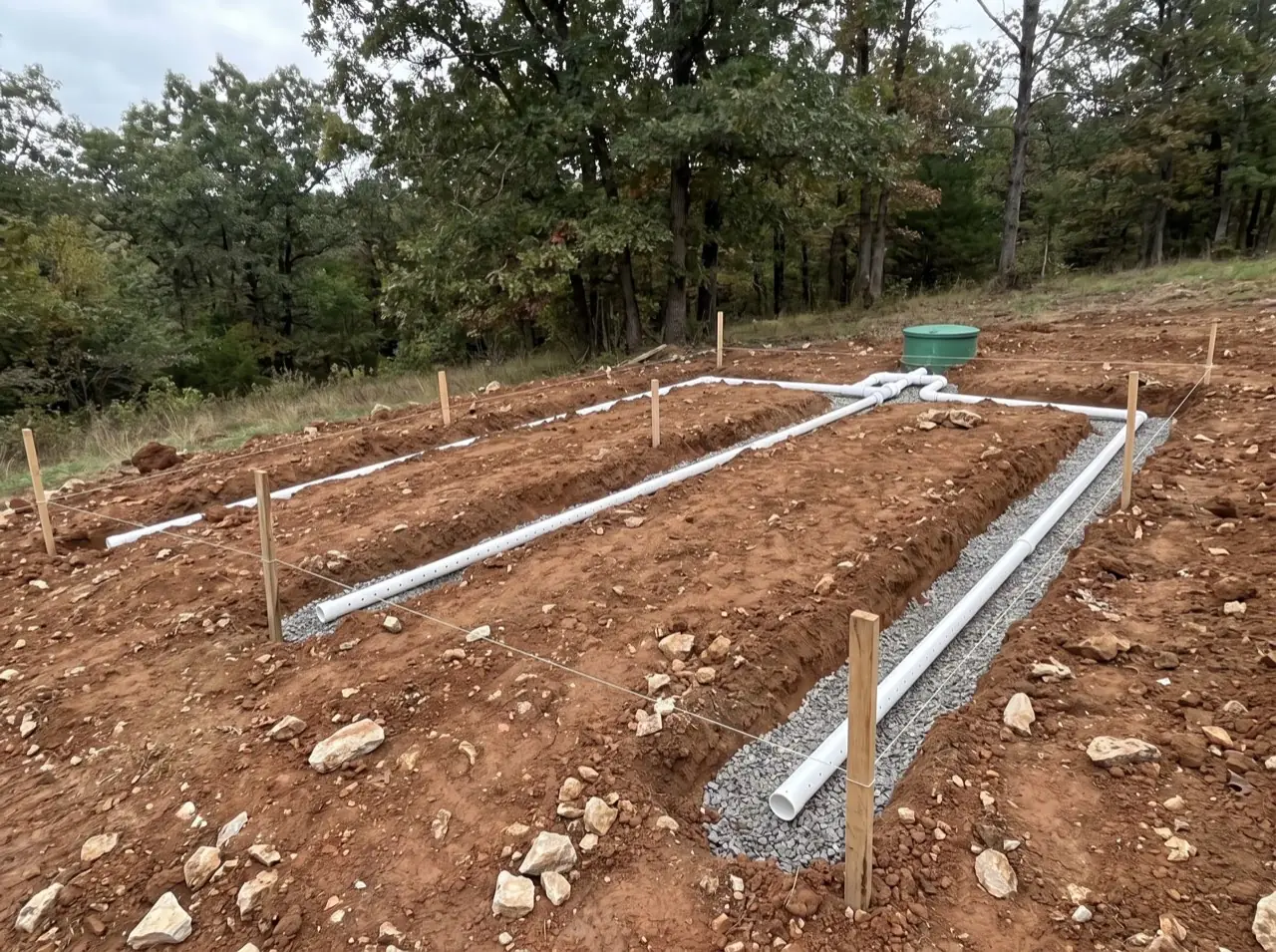
Which septic system does a lot need?
The soil evaluation decides. Good, deep soil on a gentle site usually allows a conventional gravity system. Shallow soil, slow soil, a high water table, or a steep slope usually calls for an engineered system such as low pressure pipe or drip. For a low pressure pipe system, Missouri's standards require at least 24 inches between the natural soil surface and rock, a layer that blocks water, or the seasonal high water table.
| System | How the liquid moves | Typical site |
|---|---|---|
| Conventional gravity | By gravity, from the tank to level trenches | Deep, well-draining soil on gentle ground |
| Drop box | By gravity, trench to trench down a slope | Suitable soil on a hillside |
| Low pressure pipe (LPP) | Pumped in timed doses through small pipes | Shallow or slow soil, seasonally high water table |
| Drip | Pumped through shallow drip tubing | Shallow soil, irregular lots, wooded sites |
A design may also call for an elevated sand mound, a sand filter, an aeration unit, or a lagoon, depending on the soil and the size of the property.
What does the soil evaluation measure?
How well the ground absorbs and treats wastewater, and how deep it is to rock or groundwater. A qualified soil evaluator examines the soil in test pits; some sites still use a percolation (perc) test. The result sets which systems the permitting office will approve and how large the field must be. It comes before any design or price.
What is a conventional gravity system?
A tank and a drain field of stone-filled trenches, with no pump. Perforated pipe in each trench lets the liquid seep into the soil, which does the final treatment. Where the soil is deep and drains well, it is the simplest system and costs less than an engineered one.
A standard trench is 18 to 36 inches wide, with its bottom 18 to 30 inches below finished grade. There must be at least one foot of soil between the trench bottom and rock or the seasonal high water table, and no trench may run longer than 100 feet without approval.
What is a low pressure pipe system?
An LPP system adds a pump that sends wastewater in timed doses through small perforated pipes, one to two inches across. Dosing spreads the liquid evenly and keeps it in the upper soil.
Missouri's standards place LPP pipes shallow, generally no more than 12 inches deep, in trenches at least 8 inches wide and at least 5 feet apart on center. That is why it works in thin soil over rock and in ground that stays wet.
When is a drip system used?
A drip system lays flexible drip tubing shallow in the soil, so it can follow the ground between trees and across irregular lots where straight trenches will not fit. It suits wooded, sloped, and shallow-soil lots. Like LPP, it is pumped and engineered.
Why does the installer's license matter?
Missouri licenses septic installers at two levels through the Department of Health and Senior Services. Only advanced-licensed installers may install the systems Missouri lists as advanced, and pressure systems like LPP are in that group. Much of Jefferson County is shallow soil over limestone, on slopes, so if your site needs an engineered system, a basic-licensed installer cannot build it. J1S is licensed at the advanced level and can install either kind.
Who designs the system?
The soil evaluator and, for engineered systems, a design engineer, both separate from the installer. Missouri's standards call for an LPP design to carry the seal of a Missouri-registered engineer, who sizes the pump, pipes, and field. The permit is issued from that design.
Send with your request: the property address; whether it is a new home or a replacement; the number of bedrooms; the soil report and system plan if you have them; and what the yard is like, including trees, hills, rock, and wet spots.
J1S installs septic systems in Jefferson County, Ste. Genevieve County, St. Louis County, and the counties around them, and builds from the approved design.
Sources
- Missouri Code of State Regulations, 19 CSR 20-3: minimum construction standards for onsite sewage systems, including trench dimensions and LPP requirements.
- Missouri Department of Health and Senior Services, onsite wastewater program: installer licensing.