
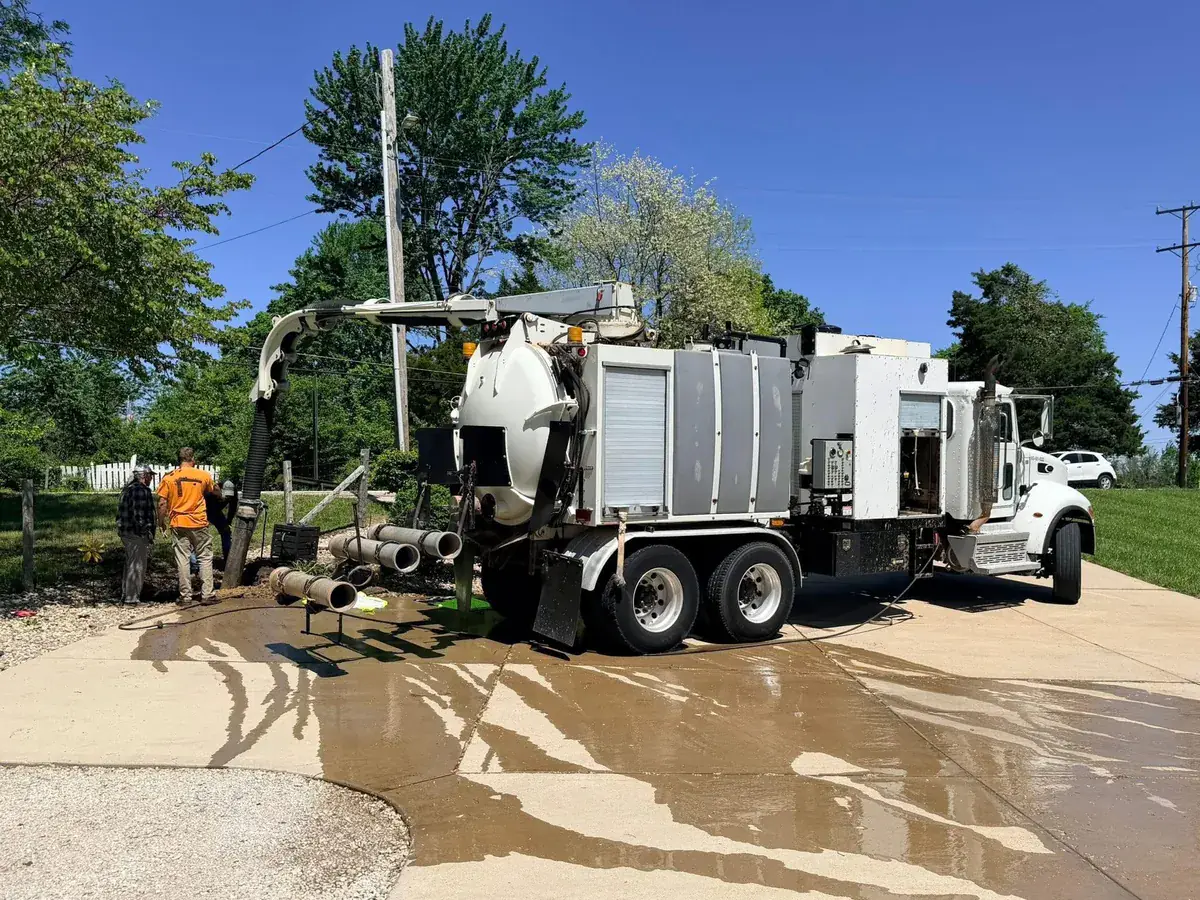
What are daylighting services?
Daylighting services expose a buried utility so a crew can see it and measure its exact position and depth before digging near it. The work is usually done with a hydrovac truck, which loosens soil with pressurized water and vacuums it into a tank, so no bucket touches the line. The same service is often called potholing.
In construction, daylighting means bringing a line into daylight at a chosen point: a gas main where a sewer trench will cross it, a fiber conduit on a planned bore path, or a water service next to a new footing. The hole is small and sized to the line being checked.
Why is daylighting done?
Locate marks show where a line is expected, within a band. Missouri law defines a marked line's approximate location as the width of the line plus two feet on either side. The marks also carry no depth: Missouri 811 says it has no information on how deep each utility is, and depths change over time with erosion, grading, and other work.
OSHA requires that when a dig approaches a buried utility's estimated location, its exact location be found by safe and acceptable means. Missouri law names hand digging or soft digging as a best practice when possible. Daylighting turns an estimated band into a measured position before a machine works inside it.
How is daylighting done with a hydrovac?
- Locate first. The Missouri 811 request goes in and the utilities respond with marks. Private lines, such as power to a detached garage or an irrigation system, need a private locator.
- Pick the exposure points. Each crossing or conflict on the plan gets a point, along with the measurements it needs.
- Set up the truck. The hydrovac parks within reach of the point, with room for the boom and hose.
- Dig with water and vacuum. The operator cuts the soil with a water jet, heated in cold weather, and the vacuum pulls the slurry into a sealed debris tank on the truck.
- Expose and measure. Digging stops when the line is visible. Its depth and position are recorded against the agreed reference.
- Close or hand off. The hole is backfilled, or left open and protected for the next trade, as agreed in the scope.
The Common Ground Alliance calls vacuum excavation an efficient, safe, and effective alternative to hand digging inside the tolerance zone, when the equipment is built for it and run by a trained operator. Some utility owners set their own rules for exposing their lines, and those rules apply too.
When is daylighting used?
- Before a trench crosses an existing line.
- Before directional boring, to confirm each crossing on the bore path.
- Before footings or an addition go in next to a service line.
- For repair access, to open working room around a damaged line.
- On sites where records are old or incomplete, or where lines were added after the drawings were made.
Do it early enough to change the plan. A crossing elevation is most useful before the trench route or bore profile is fixed.
What do you get from a daylighting job?
You get the line exposed at each agreed point, with the measurements the scope called for, such as depth from grade and offset from the locate mark. The soil goes into the truck, and J1S includes disposal in its hydrovac quotes. Backfill and surface repair are whatever the scope says, so name them in the request.
Know the limits. An exposure confirms the line at that point. Utilities can change depth or direction between holes, so every crossing that matters needs its own point. A hydrovac exposure is also not a certified survey; if an engineer or surveyor needs to record the result, schedule them to attend.
Daylighting or locating: what differs?
Locating finds a line from the surface and marks its estimated route with paint or flags. Daylighting digs down at a chosen point and shows the line itself. Locating always comes first, because it tells the crew where to dig the daylighting holes.
| Locating | Daylighting | |
|---|---|---|
| What it does | Marks the estimated route at the surface | Exposes the line at selected points |
| Who does it | Utility locators through 811; private locators for private lines | An excavation crew, usually with a hydrovac |
| Position | Within the line's width plus two feet on each side | Seen and measured at each hole |
| Depth | Not provided by Missouri 811 | Measured at each hole |
| Covers | The marked route across the work area | Only the points that are dug |
Our post on utility locating versus potholing goes further into what each step does and does not establish.
Want the longer version?
The full utility daylighting guide walks through the process step by step, how many holes a trench run takes, and how long the work runs. To book the work, the utility potholing page lists what to send, and J1S hydrovac services covers the truck and its other uses across Jefferson County and the St. Louis metro.
Sources
- Missouri Revised Statutes, Section 319.015: the approximate location of a marked line is a strip no wider than the width of the facility plus two feet on either side.
- Missouri Revised Statutes, Section 319.026: notice to the notification center before excavation, and hand digging or soft digging as a best practice when possible.
- OSHA, 29 CFR 1926.651, Specific Excavation Requirements: when excavation approaches the estimated location of underground installations, their exact location must be determined by safe and acceptable means.
- Missouri 811, Understanding Limitations in Utility Depth Information: Missouri 811 has no information on utility depths, depths vary with erosion and changes to the land, and hand digging or potholing is advised near marked lines.
- Missouri 811, Public vs. Private Utility Lines: utilities mark only the lines they own, and private lines such as feeds to a detached garage or an in-ground sprinkler system need a private locator.
- Common Ground Alliance, Best Practices 5.32, Vacuum Excavation: vacuum excavation is an efficient, safe, and effective alternative to hand digging within the tolerance zone when the equipment is purpose-built and the operator is trained, and some facility owners restrict its use.