
NULCA-certified · Hydroexcavation now available. Learn more →
Hydroexcavation

What Is Utility Daylighting? (And Why Every Contractor Should Do It Before Digging)

· 5 min read

Utility daylighting is one of those phrases that sounds more technical than it is. It means one thing: getting a visual on a buried utility before something else touches it. The consequences of skipping that step show up in incident reports.

What Daylighting Actually Means

The term comes from exactly what the process does: expose a buried utility to daylight. That's it. You dig — carefully, non-destructively — until you can see the pipe, conduit, or cable with your own eyes. You confirm its exact location, its depth, its horizontal position, and its condition. Then you document it and proceed.

Before daylighting, a utility's location is an approximation. After daylighting, it's a fact. That difference is why the practice exists and why it matters more as infrastructure ages.

The term is used interchangeably with potholing in most field contexts — both refer to the same act of exposing a utility at a specific point. Daylighting sometimes implies a longer exposure along a run; potholing is typically a single-point verification. For practical purposes, treat them as synonyms.

Why Utility Locates Aren't Enough

Call 811 and a crew will come mark the utilities at your site with flags and paint. This is required by law before any excavation in Missouri. It is not, however, the same as knowing where the utilities actually are.

Here's what the marks tell you: a utility exists somewhere in this general area. The tolerance zone for a locate mark is ±18 inches on each side of the marked line. That's a 36-inch band of uncertainty for every single marked utility. On a site with five buried services, you're operating within overlapping uncertainty bands across the entire dig zone.

That tolerance exists because the locating process itself has limitations. Locators use electromagnetic detection to trace conductive utilities — gas, electric, metallic water mains — by induction. Non-conductive utilities like PVC water lines and conduit require tracer wire to be detectable at all, and tracer wire isn't always present or intact. The accuracy of the mark reflects the accuracy of the signal.

There's a more fundamental problem: as-built drawings and utility records don't always match what's in the ground. Jefferson County has infrastructure running back decades — some of it installed before modern mapping, some of it rerouted without documentation, some of it damaged and repaired in ways that shifted it off its original alignment. J1S finds misplaced utilities during daylighting operations on a regular basis. Not occasionally. Regularly.

The tolerance zone problem in plain terms: If a gas line is marked at a point on the ground, it could be anywhere in an 18-inch radius of that mark. Add depth uncertainty — locators estimate depth, they don't measure it precisely — and the actual utility could be in a considerably different position than where the mark suggests. Daylighting removes that uncertainty before anything with force gets near it.

The Daylighting Process, Step by Step

A properly executed daylighting sequence runs like this:

  1. Call 811. Required by Missouri law. Two to three business days lead time for locators to respond. This is not negotiable and cannot be skipped.
  2. Review the locate marks. Understand which utilities are marked, where they cross the proposed trench or dig zone, and where conflicts are likely.
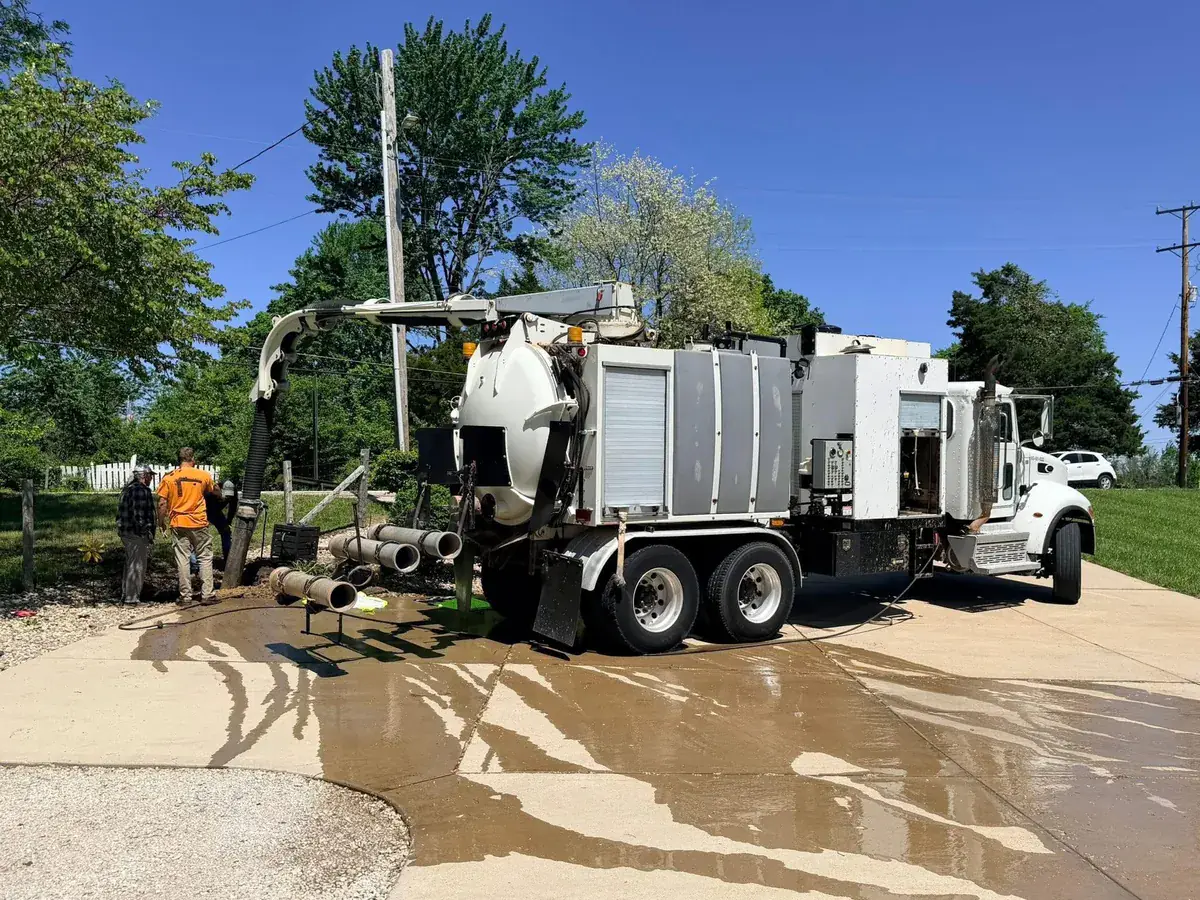
  3. Position the hydrovac. The truck needs to reach the dig zone with its boom — typically 15 to 20 feet of effective reach. On residential jobs in Festus or tight suburban corridors in Jefferson County, access planning matters here.
  4. Pothole near the marked line. The operator brings the wand in from the side — not directly on top of the mark — and works toward the utility using the vacuum to remove material as it fluidizes. Pressure is calibrated to the soil type. Jefferson County clay requires different settings than sandy fill.
  5. Expose the utility. The work continues until the utility surface is visible. No guessing, no interpreting slurry color changes — actual visual confirmation of the pipe, conduit, or cable.
  6. Measure and document. Depth from grade, horizontal offset from the locate mark, utility type, condition, and any unexpected findings. This documentation becomes part of the project record and informs everything that happens next.
  7. Proceed with the broader excavation. Now you know what's there, where it is, and how far off the marks were. The rest of the dig can proceed with that information in hand.

When Daylighting Is Required vs. Strongly Recommended

Missouri law establishes clear requirements around excavation near marked utilities. Within the tolerance zone — that 18-inch band on each side of a locate mark — mechanical excavation is prohibited. Hand tools or vacuum excavation are required. Daylighting is the practical method for satisfying that requirement while making real forward progress on a job.

Beyond the legal floor, experienced crews treat daylighting as standard practice in these situations:

  • Any dig within 5 feet of a locate mark, not just within the legal tolerance zone
  • Before directional boring — the bore path needs to be confirmed clear before a drill head goes through ground you can't see
  • Before deep trenching — the deeper you go, the more consequential a mismarked utility becomes
  • On any site where the infrastructure is old, where records are incomplete, or where previous work has been done without documentation
  • Before any utility trenching job in a congested utility corridor

The calculus is straightforward: daylighting a single utility crossing takes 1–2 hours and costs a fraction of what a strike costs. The question isn't whether you can afford to daylight. It's whether you can afford not to.

Why Hydrovac Is the Standard Tool for Daylighting

The requirement to use hand tools or vacuum excavation within the tolerance zone isn't arbitrary. It reflects a fundamental physical reality: you cannot use impact or force near a live utility without risk of damaging it.

Hand digging with a shovel technically satisfies the requirement but is impractical for anything below a foot or two of depth in Missouri clay. You're working against a soil that compacts hard, doesn't move easily, and rebounds when disturbed. A single pothole at 5-foot depth by hand in Jefferson County clay is a half-day job for two people.

Hydrovac handles that same pothole in 1–2 hours, including setup. The water fluidizes the soil, the vacuum removes it, and no impact is transmitted to whatever is buried nearby. The wand can stop within an inch of a gas line without risk of striking it. A backhoe bucket working toward the same line at the same depth has no comparable precision.

As described in more detail in our overview of how hydroexcavation works, experienced operators read the material coming out of the hole in real time. When soil transitions to something different — more compacted, different color, different texture — that's a signal. Operators respond to it before they reach the utility surface, not after.

What a Gas Line Strike Actually Means

It's worth being direct about this, because the consequences of a utility strike are severe enough that they need to be understood concretely, not abstractly.

A gas line strike triggers an immediate evacuation of the surrounding area — typically a 300-foot radius, sometimes more depending on line pressure. The gas utility dispatches emergency crews and shuts down service to every structure fed by that main, which in a residential neighborhood could mean dozens of homes. The line cannot be repaired until it's safe — and safe means no combustible atmosphere, which takes time to confirm.

OSHA investigates. The contractor who struck the line faces potential citations, fines, and civil liability for damages. Project shutdown is immediate. Restart requires regulatory clearance. The delay alone — before you calculate repair costs, fines, or liability — easily reaches five figures on a typical residential or commercial job.

The cost comparison with daylighting is not subtle. Two hours of hydrovac time against potential project shutdown, OSHA investigation, and utility strike liability isn't a close call.

Jefferson County context: The St. Louis metro area and surrounding counties have buried infrastructure ranging from newly installed to 60+ years old. In Festus and the broader Jefferson County area, it's common to encounter utilities that were installed, repaired, or rerouted without the as-built drawings being updated. When J1S encounters a utility that isn't where the marks said it would be, the daylighting process is what keeps that discovery from becoming an incident. It has happened on jobs in this area — finding a gas line 18 inches off its marked position, or a water main at 4 feet where records said 2.5 feet. These aren't hypotheticals.

How Daylighting Fits Into the Broader Excavation Workflow

Daylighting isn't a separate job — it's a phase within the excavation workflow. On a trench job with multiple utility crossings, the sequence runs: locate, daylight each crossing, document positions, then proceed with the trench between confirmed clear points.

On larger projects, a daylighting scope often runs as a separate mobilization ahead of the main excavation crew. The information gathered — exact depths, offsets, any anomalies — gets communicated to the trench crew before they arrive. That coordination eliminates the scenario where a crew is mid-trench and has to stop for an unplanned pothole because they've approached a utility crossing without confirming it first.

For contractors working in the St. Louis metro — whether in Jefferson County, St. Louis County, or across the river in Illinois — building daylighting into the project schedule as a line item rather than an afterthought is the professional standard. It's how jobs stay on schedule and how incident reports stay empty.

Schedule Daylighting

Confirm what's in the ground
before you dig into it.

J1S runs NULCA-certified daylighting crews out of Festus. We cover Jefferson County and the full St. Louis metro area.

Request a Quote Hydroexcavation Service
How Hydroexcavation Works Utility Trenching Guide