
What should I do first in an emergency?
First, check whether anyone is in danger. A gas smell, downed or exposed electric lines, or someone in or near a collapsed trench is for 911 and the utility before any contractor. Then keep people, pets, and vehicles back from the edge, stop what is feeding the problem, and do not start digging.
If anyone could be hurt
- Gas smell or a hissing line. Leave the area, do not operate switches or vehicles nearby, and call 911 and the gas utility from a distance.
- Downed or exposed electric lines. Stay away and call the electric utility.
- Someone in or near a collapsed trench. Call 911. Do not enter the trench; a second collapse is common.
Soil at the lip of a hole or collapse can give way without warning. OSHA's excavation rules exist because unprotected trenches kill people every year.
How do I stop the damage?
| Problem | What to do | Keep in mind |
|---|---|---|
| Water line break | Shut the water off: the main valve inside the house for a house-side break, or the valve at the meter for a break between the meter and the house | The water provider can close the meter valve if you cannot |
| Sewer backup | Stop using water in the building; every flush and load of laundry adds to the backup | If the backup follows heavy rain, tell the contractor |
| Washout or sinkhole | Divert surface water away from the hole from a safe distance | Do not fill it; fill hides the cause and usually has to come back out |
Not sure whose water line it is? See our water line repair guide.
Why not start digging?
Buried gas, electric, and communication lines run through the same ground as the pipe that failed, and an emergency does not suspend the requirement to have them located. Missouri 811 takes emergency locate requests; the excavator normally makes that request. Near marked or suspected lines, a professional crew exposes them by hand or with hydrovac before any machine digs. That is slower than a bucket for the first few feet and much faster than repairing a second utility.
What to tell dispatch
Have ready: the address and the best way in; what is happening and when it started; whether water and gas are shut off; what is above the problem, such as a driveway, slab, or street; any locate marks, old repairs, or camera footage; and a phone number that will be answered.
Photos help. One wide shot showing where the problem sits on the property is worth more than five close-ups of mud.
What the crew does on arrival
- Makes the area safe. Barricades, shoring or sloping for any trench people will enter, and utilities located.
- Finds the failure. A camera for sewer lines, exposing the pipe for water breaks, probing or digging for voids.
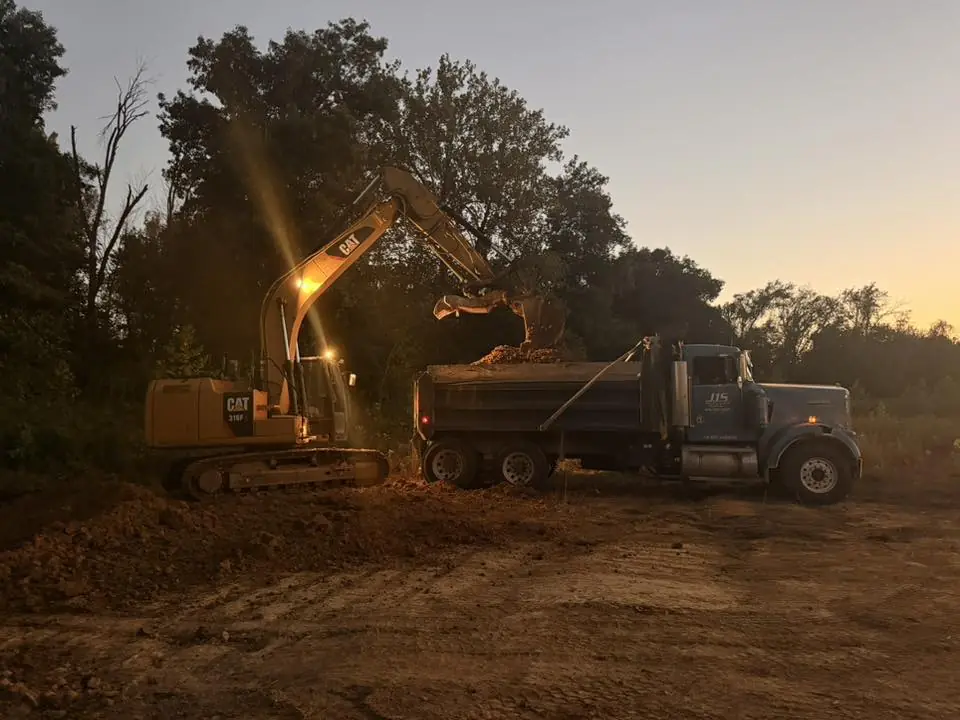
- Exposes and repairs. Soft digging near utilities, a machine where it is clear, then the repair.
- Backfills to a safe condition. Compacted in lifts. Final restoration, such as concrete, asphalt, or sod, is often a separate daylight visit.
Ask which parts are being done tonight and which are being scheduled for later.
What it costs, and what to keep
After-hours response costs more than scheduled work, and an emergency is quoted with less information. A straightforward contractor will tell you what is known, what is not, and how changes will be priced once the ground is open. For insurance and the next owner, keep photos, camera footage, any permit and inspection, and the invoice describing what was repaired and where.
Calling J1S
J1S responds 24 hours for active sewer and water emergencies across Jefferson County and the St. Louis metro, with excavation, hydrovac, and licensed sewer and water repair under one company. Call dispatch at (636) 331-5757. For anything that can wait until morning, request excavation the normal way and send the details above.