
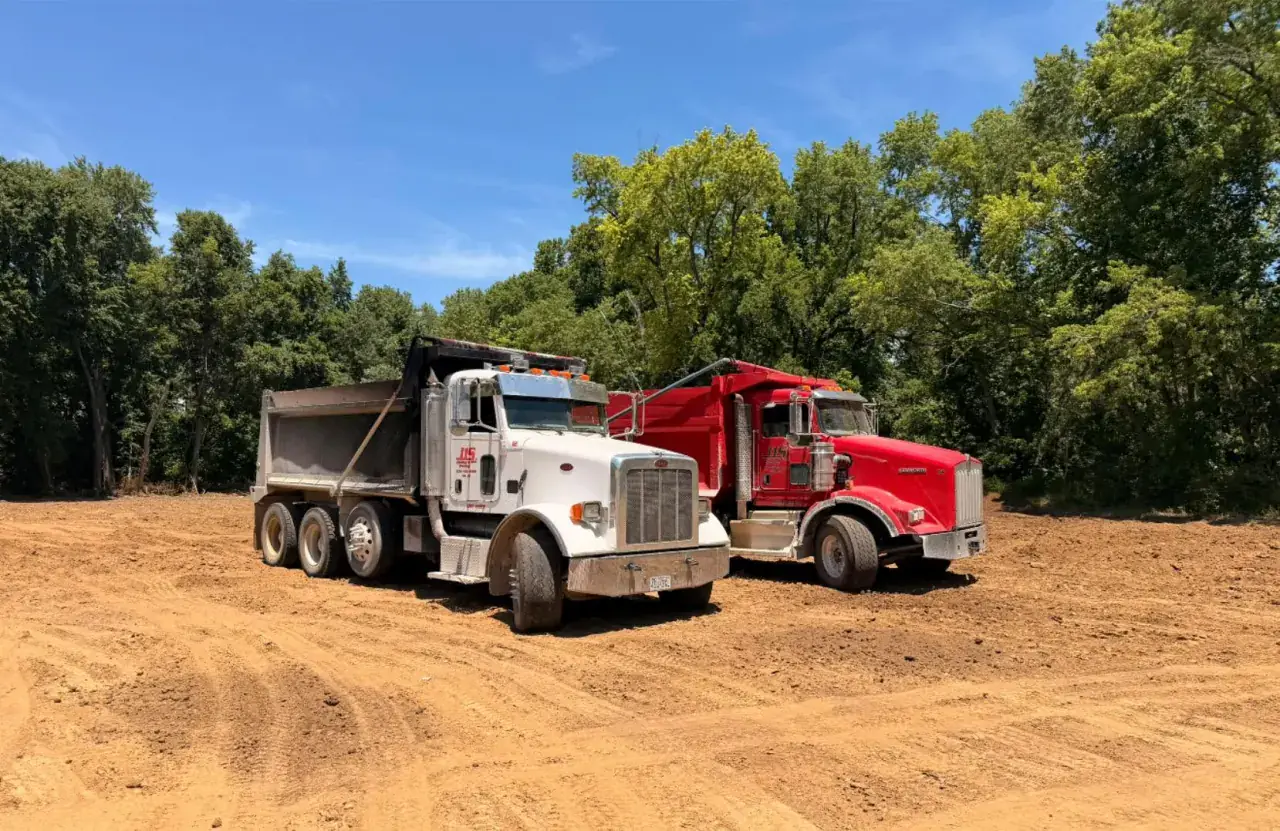
How much does a quad-axle truck hold?
A quad-axle dump truck holds about 14 cubic yards per load. By weight that is roughly 18 to 19 tons of crusher run or 16 to 18 tons of #57 stone, because heavy material reaches the legal weight limit before the bed is full.
Yards measure space; tons measure weight. Stone is sold by the ton, so a full load of one material is a different tonnage than a full load of another. Moisture and the quarry change it a little too.
Tons per quad-axle load
| Material | Tons per load | Typical use |
|---|---|---|
| Crusher run (#411) | 18 to 19 | Driveway base, parking |
| #57 stone | 16 to 18 | Drainage, driveways |
| Fill dirt | 17 to 18 | Raising grade, backfill |
| Topsoil | 14 to 16 | Grading, finish work |
| Sand | 17 to 18 | Pipe bedding, base prep |
| Rip rap | 18 to 19 | Erosion control |
To work out tons for your own job, see the driveway gravel guide. Most material comes off the Festus materials yard.
If a quad-axle cannot fit, a tandem-axle truck is shorter and turns tighter. It carries less, so the same job takes more trips.
How is dump truck hauling priced?
Material delivery is typically priced per load: the material cost plus a delivery charge that scales with distance from the Festus yard. Project haul-off, like demo debris or excavation spoil, is usually priced hourly because billing reflects how long the truck is tied up loading, hauling, and waiting. Both include mobilization, the cost of getting the truck to and from your site.
| Job | Priced | Example |
|---|---|---|
| Material delivery | Per load, plus delivery | A driveway needing 40 tons of crusher run is three loads. |
| Haul-off | Hourly | Demo cleanup or moving dirt from a dig, where loading and waiting time varies. |
Delivering to Festus or Crystal City costs less to mobilize than going to the rural edges of the county or into the St. Louis metro. Full loads are better value than several small ones, because you pay to move the truck either way.
Combine trips when you can. If you need fill delivered and dirt hauled off, schedule them together. The truck drops fill and loads spoil (the extra dirt from digging) for the return run, so it does not drive back empty and you do not pay mobilization twice.
What can you haul?
Both directions. Material delivery includes topsoil, fill dirt, crusher run, #57 stone, rip rap, and sand off the Festus yard. Haul-off includes excavation spoil, demolition debris, broken concrete and asphalt, brush and land-clearing waste, and general construction debris. On many jobs a single truck delivers material and hauls spoil away on the return trip.
Check site access first
Most delivery problems come from access, not the material. Before delivery day, check:
- Overhead clearance. Low branches and utility lines stop a raised dump bed. Check the whole route and the spot where the bed goes up.
- Firm ground. A loaded truck ruts or sinks in soft ground, a wet lawn or a soaked dirt drive. If the ground will not hold it, the truck dumps where it can.
- Room to turn or back out. Know where the driver turns around before the truck arrives.
- Where to dump. Pick the exact spot. Moving a 15-ton pile by hand is a miserable afternoon.
Jefferson County has clay soil, which holds water. Ground that carried a truck in August may not in March, and sometimes the right call is to wait a day or two for it to firm up. Many properties also sit at the end of a few hundred feet of gravel or dirt drive. Flag low branches and the lack of a turnaround before delivery day.
Common questions
Can you haul the same day?
Often, yes. For local Jefferson County deliveries, same-day turnaround is frequently available when you call early in the day and the material is stocked at the Festus yard. Crusher run, #57 stone, fill dirt, and topsoil are kept on hand. It depends on truck availability and the day's schedule, and the closer you are to Festus the easier it is to accommodate.
Do you provide scale tickets?
Yes, when a project requires documented weights. Loads can be run across a certified scale and a scale ticket issued for each one, recording the material and certified gross and net weight. Most residential deliveries do not need this, but for commercial jobs or specs that require proof of quantity, ask for scale tickets when you request the quote so it is built into the job.
See the Jefferson County hauling page, our hauling services, or the Jefferson County services hub.
Sources
- Missouri Revised Statutes, Section 304.180, Regulations as to weight: the legal axle and gross weight limits that cap how much a loaded truck can carry.
- Missouri Department of Agriculture, Device and Commodity Inspection Program: annual state inspection of commercial scales, including large scales at rock quarries.