
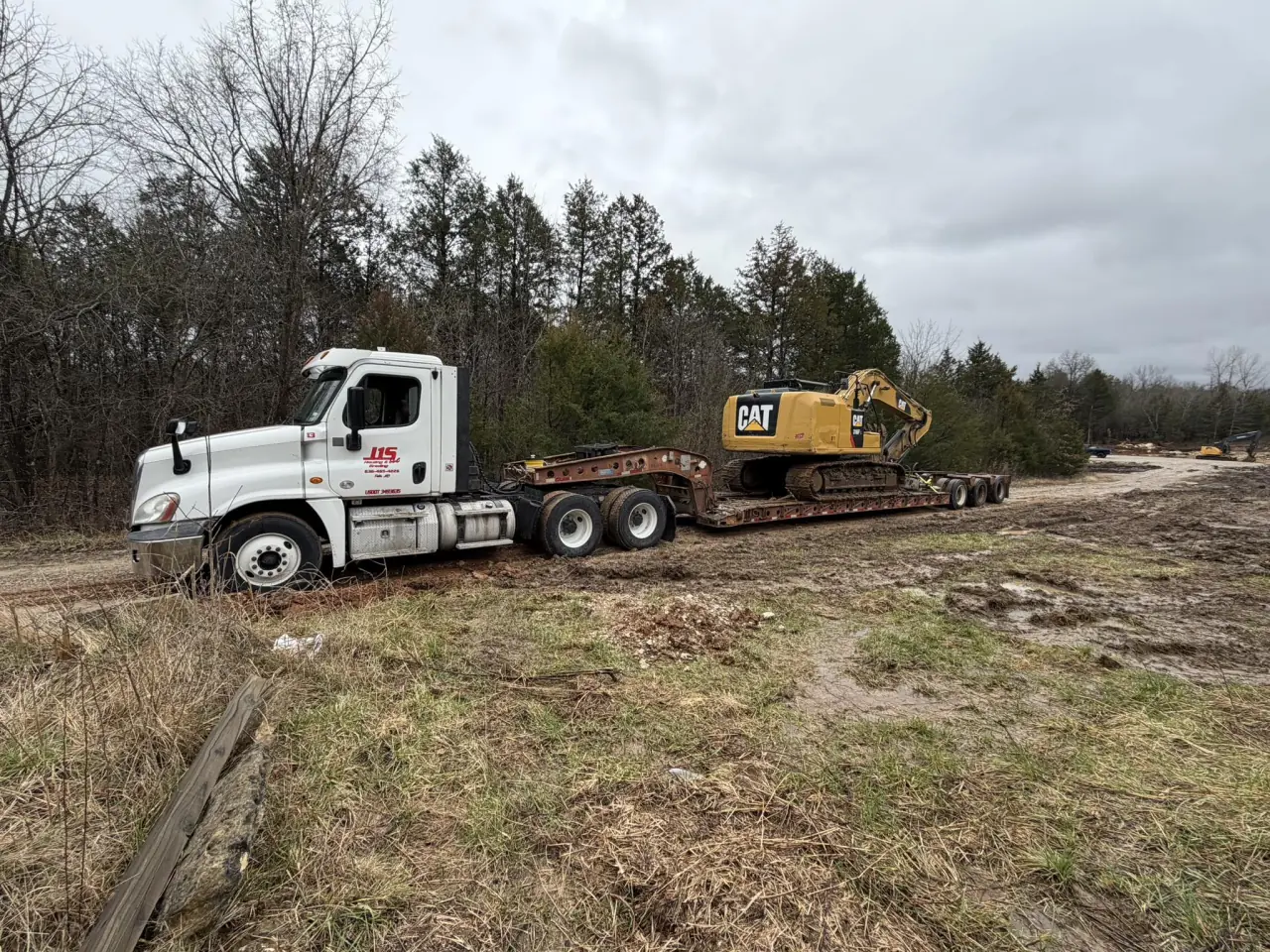
What does a lowboy move involve?
A lowboy is a trailer with a deck that sits close to the ground, so tall machines stay under bridge and wire clearances. A move has five parts: confirming the machine's weight and dimensions, choosing the route, getting any permit, loading and securing the machine, and unloading at the other end.
The hauler needs the facts before dispatching a truck. A machine that turns out to be heavier or wider than described can make a legal load into one that needs a permit, and that cannot be fixed at the roadside.
When does a Missouri load need a permit?
A load needs a Missouri oversize or overweight permit when it is wider than 8 feet 6 inches, taller than the legal height for the route, or heavier than 80,000 pounds gross. Legal height is 13 feet 6 inches on most highways and 14 feet on interstates and designated routes. MoDOT publishes the rules in its oversize and overweight permit regulations.
| Measure | Legal limit without a permit |
|---|---|
| Width | 8 feet 6 inches |
| Height, most highways | 13 feet 6 inches |
| Height, interstates and designated routes | 14 feet |
| Gross weight | 80,000 pounds |
Many mid-size and larger excavators and dozers are wider than 8 feet 6 inches on their tracks, so a permit is common for those moves. Height is measured with the machine on the trailer, not standing on the ground. A permitted load may also be limited to certain routes and hours.
J1S handles routing for oversized loads and can obtain permits for the moves that need them. A permit adds lead time, so tell dispatch early.
What should I tell the hauler?
Have ready: make and model; operating weight with the attachments that are on it; overall width, height, and length; whether it runs and steers; pickup and drop-off addresses; who will be on site at each end; and the date and time window.
The make and model let the hauler look up the base weight, but attachments change it. A hydraulic hammer, a thumb, or a wide bucket can add enough weight or width to matter. If you are unsure, send a photo of the machine's data plate.
Say whether the machine runs. A machine that cannot drive onto the trailer needs a different loading plan and usually a second piece of equipment.
What does the site need at each end?
- Room to load. The truck and trailer need a straight, firm stretch longer than the rig itself, plus space for the machine to line up with the ramps.
- Firm, level ground. Loading on a slope or soft shoulder is where machines slide off ramps. A paved lot or compacted gravel is best.
- Overhead clearance. Look for power lines and tree limbs along the approach and above the loading spot.
- An entrance the rig can make. A lowboy does not turn like a dump truck. Tight gates, culverts, and sharp turns off narrow roads need to be mentioned in advance.
The same access questions come up with material deliveries. Our truck access checklist covers culverts, soft ground, and overhead lines in more detail.
How much notice does a move need?
For scheduled work, 24 to 48 hours of notice lets the move be planned around trucks and site schedules. Same-day or next-day moves are sometimes possible; call dispatch and ask. A load that needs a permit should be booked earlier, since the permit has to be in hand before the truck rolls.
Rental returns are worth planning from the first day of the rental. If the machine is due back on a Friday, book the pickup when the machine arrives, not on Thursday afternoon.
What J1S hauls
J1S moves excavators, dozers, skid steers, compactors, and motor graders on its lowboy for contractors, rental companies, and owners across Jefferson County and the St. Louis metro. The fleet runs from an F-550 to a 9-axle rig, so the truck is matched to the load. See equipment hauling for the service, or dump truck hauling if the job is moving material instead of machines.