
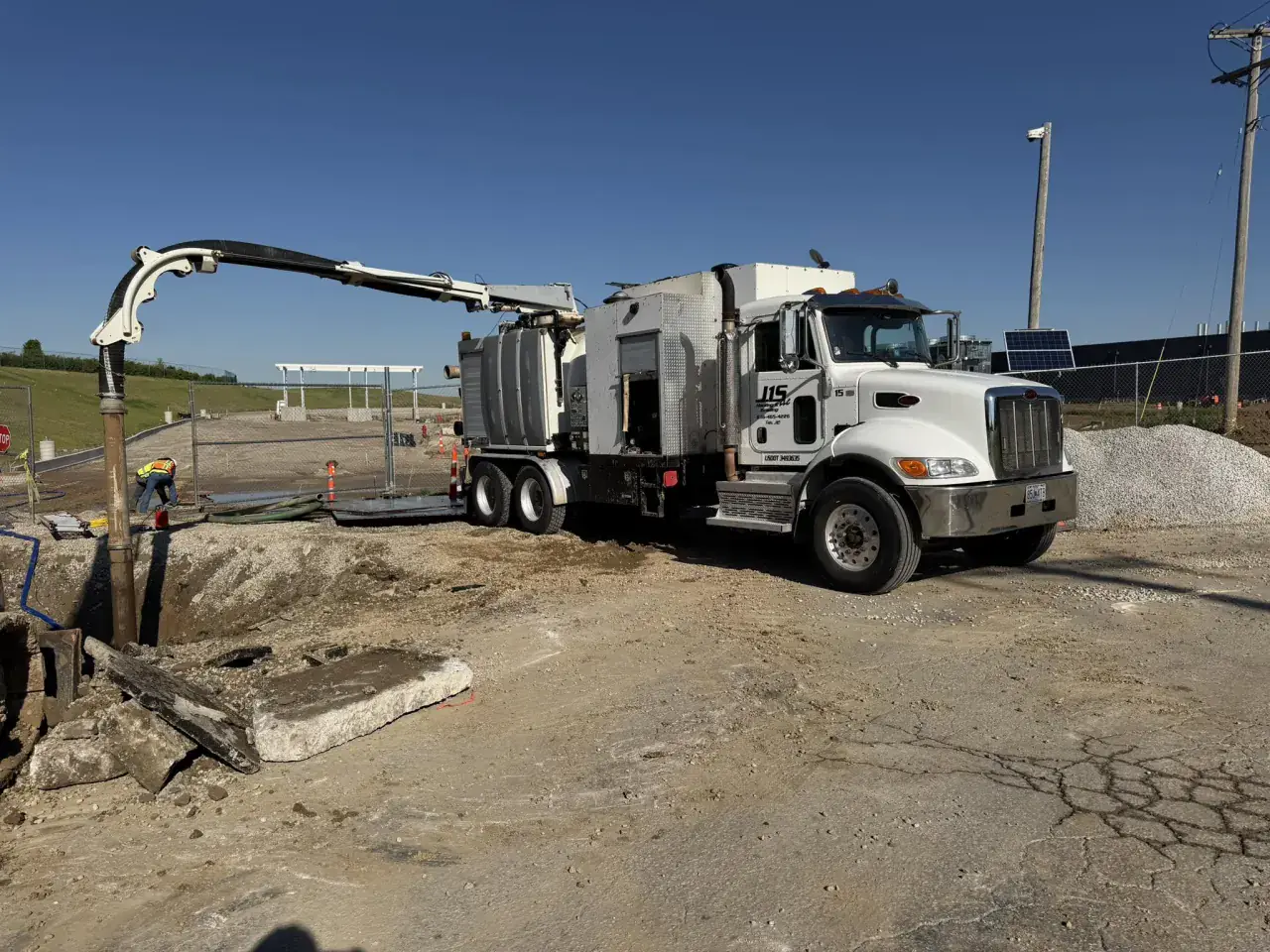
How does hydroexcavation work?
Hydroexcavation breaks up soil with water pressurized to 2,000 to 3,000 PSI, then vacuums the resulting slurry into a sealed tank on the truck. Because nothing rigid touches the ground, it can expose buried pipes and cables without striking them.
The water does not blast the soil; it turns it into thick mud, and the vacuum pulls that mud up the boom as fast as it forms. The operator can stop the moment the soil changes or a pipe comes into view. A backhoe bucket cannot do that.
What's on the truck?
| Part of the truck | Typical figure |
|---|---|
| Water tank | 500 to 1,500 gallons |
| Water pressure at the wand tip | 2,000 to 3,000 PSI |
| Vacuum pump | 27 to 28 inches of mercury |
| Debris tank | 10 to 12 cubic yards |
| Boom reach from the truck body | 15 to 20 feet |
| Effective digging depth | 15 to 20 feet for most units |
Many units carry a water heater for frozen ground. J1S runs purpose-built vacuum excavation trucks, not converted septic vacs.
What happens on the day?
- Call 811 first. Missouri law requires it before any digging, including vacuum excavation. Notice must go in at least two working days before the dig. J1S won't skip it.
- Park within reach. The boom reaches 15 to 20 feet from the truck, so tight lots need a plan.
- Set up. Boom out, nozzle placed, pressure set for the soil, marks checked. This takes 20 to 45 minutes on most residential jobs.
- Dig. Clay and frozen ground often need higher pressure; sandy soil digs with more control at lower pressure. The operator adjusts as the material changes.
- Haul the spoil. The mud cannot be dumped on site. It goes to a permitted disposal site, and J1S includes disposal in the quote.
- Backfill. Missouri clay is a poor fill. Road cuts and structural spots get granular fill in compacted 6 to 8 inch layers. Surface repair, such as asphalt, concrete or sod, is set in the quote.
The open hole then gives the next trade access: a plumber for sewer line access and repair, a utility trenching crew, an inspector checking depth, or a locator confirming a line the drawings had wrong. For pricing, see hydrovac cost.
When is a hydrovac the wrong tool?
Hydrovac is precise, not fast at volume. To move 300 yards of dirt for a foundation on a site with nothing buried, a track excavator is faster and cheaper. Hydrovac pays off near utilities, in crowded corridors and tight spaces, or anywhere a strike would do real damage. See hydrovac vs. traditional excavation, and what NULCA certification means for operator training. J1S will tell you when another method suits your job better.
Common questions
How deep can a hydrovac excavate?
Most hydrovac units are effective to 15 to 20 feet of depth. Beyond that, vacuum efficiency drops significantly as the vertical lift increases. For most utility exposure and potholing work in Jefferson County and the St. Louis metro, 15 feet covers nearly every practical application.
How long does a hydrovac job take?
A single pothole, exposing one utility at a known location, typically takes 1 to 2 hours from setup to cleanup. Slot trenching depends on linear footage and soil conditions. Most residential utility access jobs in the St. Louis area run a half day, including setup, the dig, and basic backfill.
Do I need to call 811 first?
Yes. Missouri law requires an 811 ticket before any excavation, including vacuum excavation. Call 811, wait for utilities to be marked (the notice period is at least two full working days after the day you call), then schedule the dig.
Can hydrovac work in winter?
Yes. Hydrovac units with a water heating system can cut through frozen ground. A backhoe struggles with frost-hardened soil, while heated water cuts through it without the impact that can harm buried utilities.
Sources
- Missouri Revised Statutes, Section 319.026: an excavator must notify the notification center at least two working days before starting an excavation.
- OSHA, 29 CFR 1926.651, Specific Excavation Requirements: the estimated location of underground utilities must be determined, and the utility owners contacted, before an excavation is opened.