
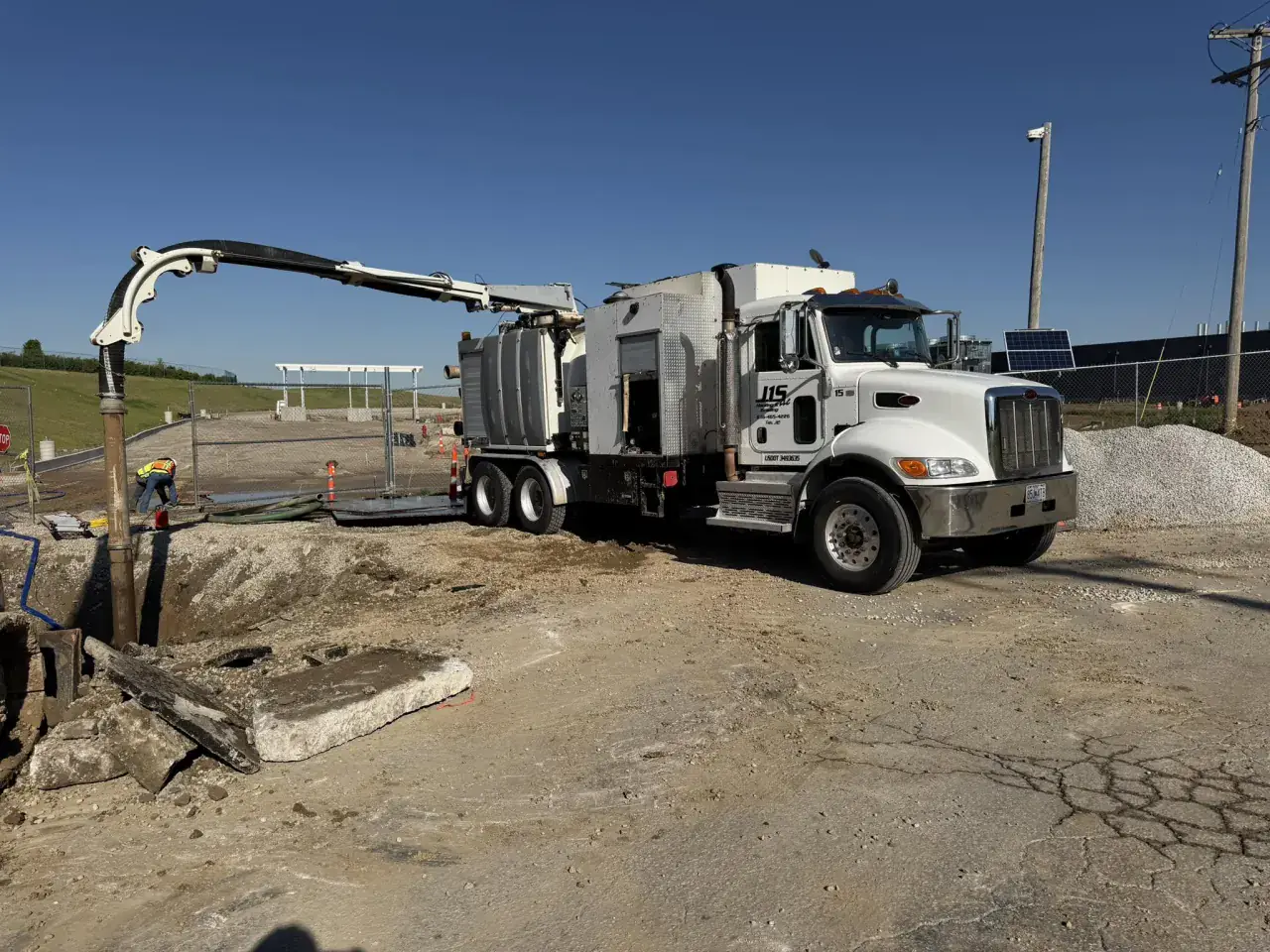
Hydrovac or backhoe: what is different?
Hydrovac digs with pressurized water and a vacuum, so it can expose buried lines without striking them, while traditional excavation uses a steel bucket that is faster and cheaper for bulk digging. The dividing line is the two feet on either side of a marked utility, which Missouri treats as a hand-dig zone and where hydrovac replaces the bucket.
Side by side
| Factor | Hydrovac | Backhoe or excavator |
|---|---|---|
| Utility safety | Safer; damage still possible if done wrong | High risk near utilities |
| Cost per hour | Higher | Lower |
| Speed | Slower | Faster |
| Best for | Utility daylighting, tight sites, sewer repair | Open sites, foundations, bulk earthwork |
| Frozen ground | Works with heated water | Difficult or impossible |
| Access | Reaches past obstacles with its hose | Equipment must reach directly |
| Tree roots | Preserves root systems | Damages or destroys roots |
Hydrovac, also called hydroexcavation or vacuum excavation, breaks up soil with high-pressure water and vacuums the slurry (soil and water) into a tank on the truck. A backhoe's steel bucket cannot tell dirt from a live gas line.
When to always use hydrovac
- Any dig within two feet of a marked utility. Missouri defines a marked line's approximate location as its width plus two feet on either side, and that strip is a hand-dig zone.
- Utility daylighting and potholing. Exposing buried lines to confirm their depth and position before a larger dig.
- Sewer repair digs. When a camera finds a problem, the repair dig needs precision.
- Older lots with unknown lines. Utility records in older Jefferson County and St. Louis neighborhoods often do not match what is in the ground.
- Fiber, gas, or electric close by. A gas strike can end a project, and a fiber cut costs someone thousands in downtime.
When a backhoe is the right call
- Open-field foundations on a site with verified utility locations
- Bulk earthwork, mass grading, and site clearing
- Ponds and lakes, where thousands of yards move
- Road cuts, topsoil stripping, and rough cut work on open sites
Most large projects use both: a machine for the bulk work and hydrovac for the digs around existing lines. J1S runs both and will tell you which fits your project before you sign anything.
Why NULCA certification matters
Nulca, formerly the National Utility Locating Contractors Association, certifies vacuum excavation operators in safe work practices, equipment operation, damage prevention, and regulatory compliance. If an uncertified operator strikes a utility on your site, who is responsible gets complicated fast. J1S hydrovac operators are NULCA-certified, so you can document that the crew on site was qualified for the work.
Common questions
When must I use hydrovac?
Use hydroexcavation any time you are digging within two feet of a marked utility, performing utility daylighting or potholing, doing sewer repair digs, or working on a site with unknown or aging underground infrastructure. The risk of a utility strike with mechanical equipment in those situations outweighs the cost difference.
Is hydrovac more expensive?
Per hour, yes. Add in the cost of a utility strike, from emergency repairs and outages to liability and delays, and hydrovac is nearly always the right choice near buried utilities. On clean open sites with no utility risk, a backhoe costs less. See what hydro excavation costs.
Can hydrovac dig frozen ground?
Yes. A hydrovac with heated water can thaw and dig through frost, while a backhoe struggles to get into hard-frozen soil. See hydrovac in frozen ground.
Sources
- Missouri Revised Statutes, Section 319.015: the approximate location of a marked line is defined as the width of the facility plus two feet on either side.
- OSHA, 29 CFR 1926.651, Specific Excavation Requirements: when an excavation approaches the estimated location of an underground utility, its exact location must be determined by safe and acceptable means.
- Nulca, About: the organization was formerly known as the National Utility Locating Contractors Association.