
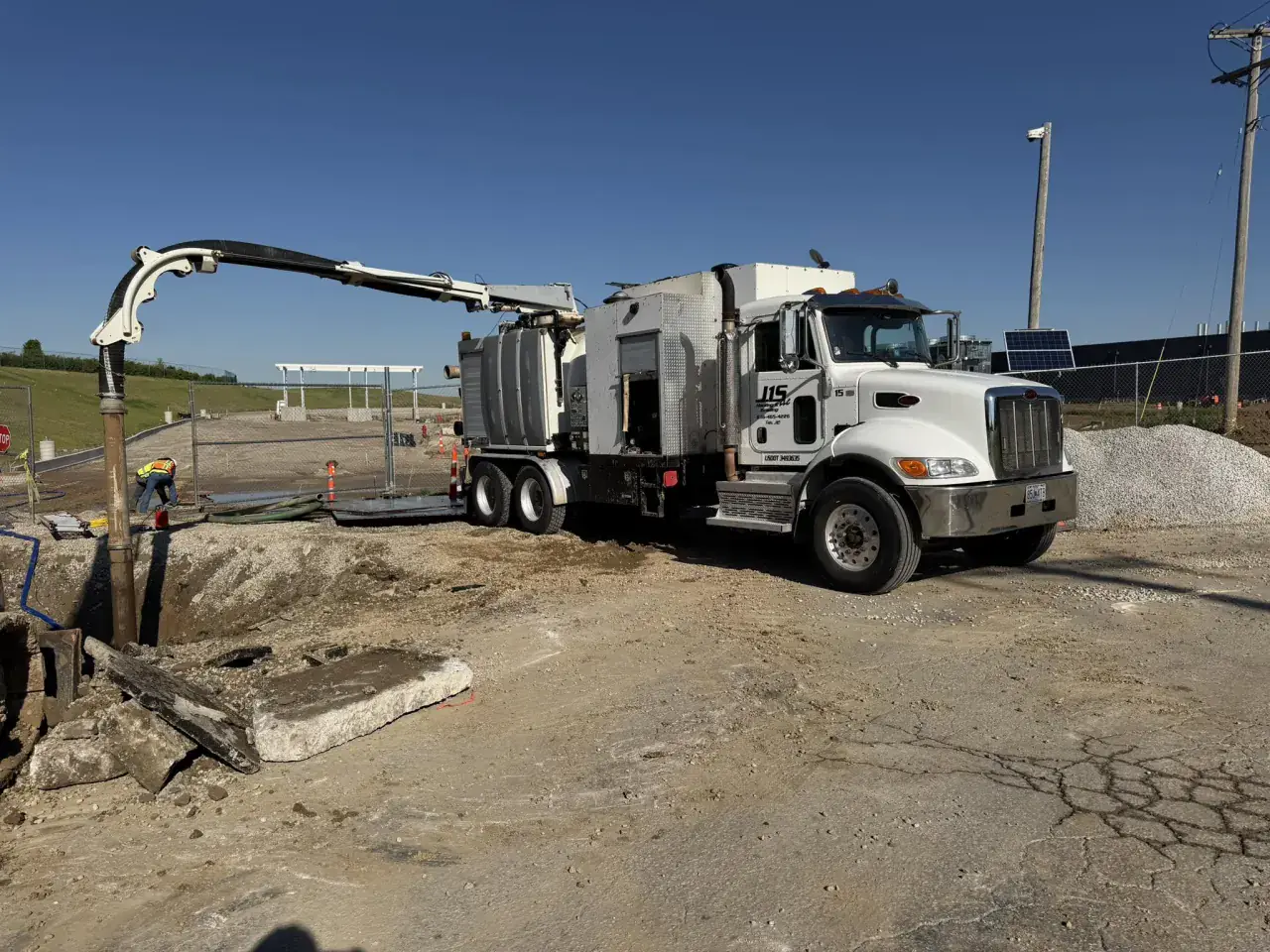
When should I use hydrovac?
Use hydrovac whenever the dig is inside the two-foot zone on either side of a marked utility, or where lines are crowded, unknown, or fragile. On open ground outside that zone a machine is faster: an excavator can move about 300 cubic yards in a day, against 20 to 30 for a hydrovac.
Which tool for which job?
| Job | Use |
|---|---|
| Digging within 2 feet of a marked line | Hydrovac or hand digging |
| Potholing to confirm where a line is | Hydrovac |
| Slot trench through a crowded corridor | Hydrovac |
| Near fiber optic cable | Hydrovac |
| Backyards and tight access | Hydrovac |
| Paved or landscaped surface to restore | Hydrovac |
| Bulk digging with utilities confirmed clear | Excavator |
| Basements and large site prep | Excavator |
| Demolition spoil, rock, topsoil stripping | Excavator |
Why hydrovac near utilities?
Hydrovac loosens soil with pressurized water and vacuums it out, so an experienced operator can stop within an inch of a buried line without touching it (see how hydroexcavation works). It sends no impact into the soil, which matters near fiber optic cable: a backhoe near miss in hard clay can sever it. It cuts only the size of hole needed, so there is less surface to restore, and its boom reaches 15 to 20 feet, so the truck can stay on the street while it digs in a backyard or between buildings.
It is also fast at exposing lines. A pothole 5 to 6 feet deep in Jefferson County clay takes 1 to 2 hours with a hydrovac, and most of a day for two people with hand tools.
The two-foot hand-dig zone
Missouri law defines the approximate location of a marked utility as its width plus two feet on either side, and Missouri 811 treats that strip as a hand-dig zone. Expose the line by vacuum or hand excavation before a machine works there. This applies to gas, electric, telecom, water, sewer, and any other marked utility, with no exception for small lines or low-pressure mains. On crowded sites these zones overlap, and a whole trench run can fall inside one.
When an excavator is better
For bulk digging with confirmed utility clearance, such as foundations, ponds, detention basins, and site clearing, an excavator is faster and cheaper. Hydrovac works best at about 5 to 15 feet deep, and its debris tank holds 10 to 12 cubic yards, so on bulk work it fills fast and stops for disposal runs.
Is the extra hourly cost worth it?
Hydrovac runs $150 to $250 an hour; a track excavator runs $100 to $175. That is a $50 to $75 an hour premium. A utility strike on a routine commercial job (gas evacuation, OSHA investigation, shutdown, repairs, and liability) can easily exceed $50,000. Preventing one strike pays for the premium.
Most jobs use both
A typical utility trench in an established St. Louis suburb runs like this: hydrovac potholes each utility crossing, an excavator digs the clear straight runs between them, and the hydrovac returns for the final approach to each crossing. In a crowded utility easement, run the hydrovac along the whole crowded stretch, not just the crossings. A NULCA-certified operator knows where to switch; see hydrovac vs. traditional excavation.
Quick check: Are there marked utilities within 5 feet of the dig? Is access too tight for a full-size machine? Does the surface need to be preserved? Is there fiber optic cable anywhere in the corridor? If any answer is yes, call a hydrovac crew. If all four are no and you are moving more than 50 cubic yards, an excavator is probably the right call.
Common questions
Can I use a backhoe near marked lines?
Only outside the hand-dig zone, which under Missouri law is the width of the marked line plus two feet on either side. Inside that strip, expose the line by vacuum or hand excavation first. A backhoe outside the zone on a confirmed-clear section of trench is often the right call.
Is hydrovac slower than a backhoe?
Yes, for bulk digging. A track excavator can move 300 cubic yards in a day on open ground; a hydrovac might move 20 to 30. For exposing utilities, hydrovac is faster than hand tools, the other legal option inside the hand-dig zone, and it avoids the strike risk a backhoe brings.
Sources
- Missouri Revisor of Statutes, RSMo 319.015: defines the approximate location of a marked facility as its width plus two feet on either side.
- OSHA, 29 CFR 1926.651, Specific excavation requirements: requires the exact location of underground installations to be found by safe and acceptable means as digging approaches them.