
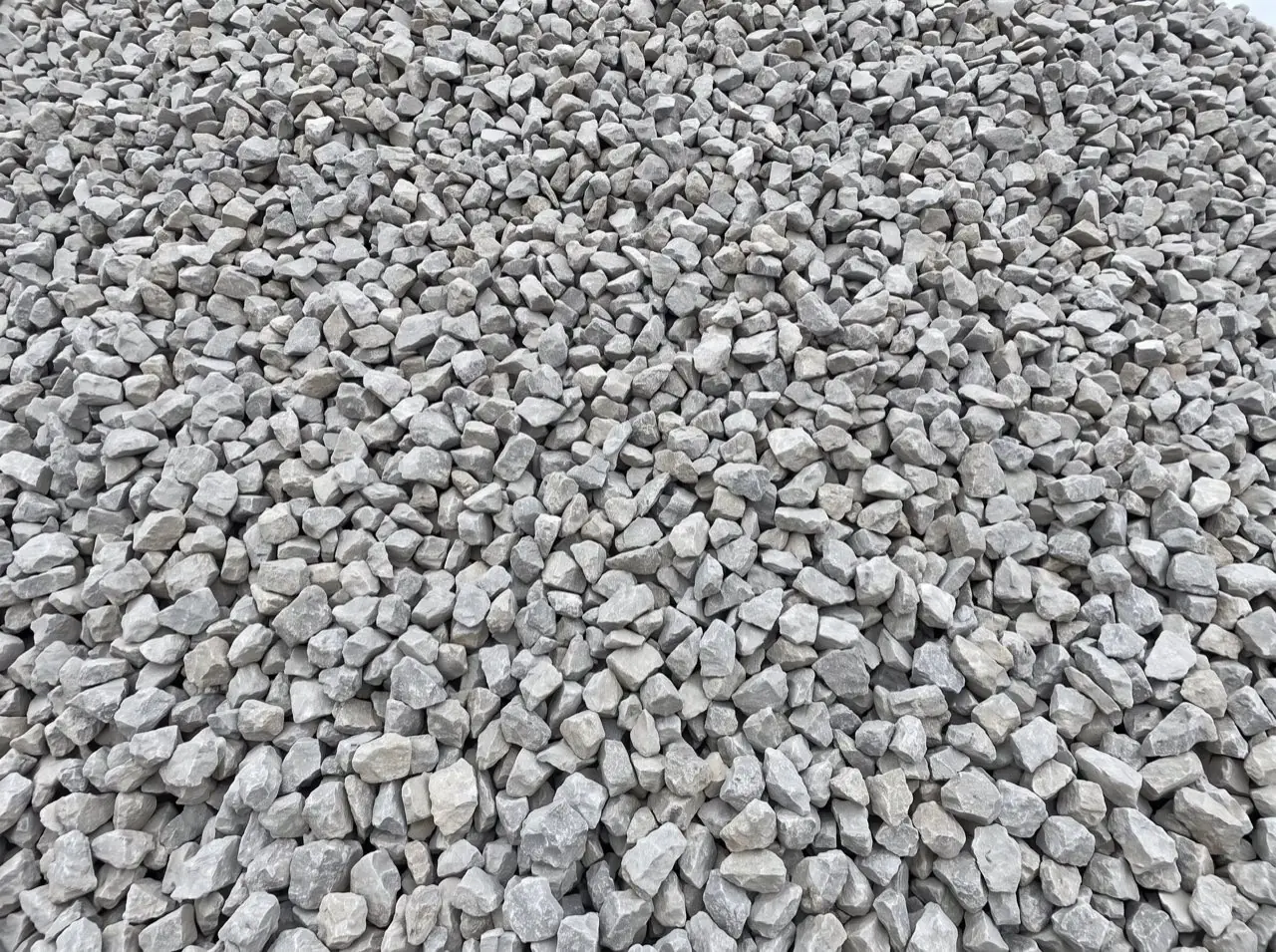
How do #57 and #4 stone differ?
#57 stone is about ¾ to 1 inch across and #4 stone is about 1 to 1½ inches, so each piece of #4 is roughly twice the volume. Both are clean, angular limestone with no fines: #57 is the standard for French drains and driveway surfaces, and #4 is used for high-flow drainage and for bedding pipe 8 inches and larger.
Which one should I order?
| Job | Order |
|---|---|
| French drain around 4 or 6 inch pipe | #57 |
| Bedding under 4 or 6 inch utility lines | #57 |
| Foundation and footing drains | #57 |
| Moisture break under a concrete slab | #57, a 4 inch layer |
| Visible areas: beds, under decks | #57 |
| Bedding 8, 10, or 12 inch sewer or storm pipe | #4 |
| Drain at a low point fed by a large area | #4 |
| Drainage layer under heavy loads | #4 |
| Driveway or slab base | Neither: use crusher run |
For most home drainage jobs in Jefferson County, #57 is the right default. If you are working to engineered plans or a permit, the spec sheet names the stone; order what it says.
Why #57 is the usual choice
#57 is washed, crushed stone graded to the ASTM #57 specification. "Washed" means the dust, sand, and silt are removed, so water moves straight through. It is small enough to pack around standard 4 and 6 inch perforated pipe and uniform enough to look clean where it shows. When plans call for "drainage stone" without saying more, they almost always mean #57. Residential drainage permits for new construction typically name it.
When #4 is the better pick
#4 is the same washed limestone, larger. Bigger pieces leave bigger gaps, so it moves more water and clogs more slowly. Under 8 inch and larger pipe it seats properly, where #57 can allow point loading and the line can deform over time. Commercial and municipal stormwater projects may specify #4 or larger for underdrains. The price difference is minor, so order the size the job calls for.
What both have in common
- Neither compacts. They are drainage stone and give no structural support. For a firm, fine surface like a paver base or path, use limestone screenings.
- Both need filter fabric in drains. Geotextile fabric keeps soil from washing into the gaps and clogging the drain over time.
- Both are limestone in Missouri, with the same angular shape and freeze-thaw durability.
How much to order
Cubic yards = length (ft) x width (ft) x depth (in) / 324
Example: a 100 foot French drain with a 2 foot wide stone envelope 12 inches deep is about 7.5 cubic yards.
As a rough guide, 1 cubic yard covers about 100 square feet at 3 inches deep. A French drain typically has 6 to 12 inches of stone around the pipe, wrapped in fabric. J1S delivers both by the ton and by the truckload, and dispatch confirms the tonnage. See #57 limestone and #4 clean stone. For smaller quantities, contact us about options. Working from drawings? Call before ordering.
Common questions
Can I use #57 under a concrete driveway?
Yes, as a moisture break and drainage layer, typically 2 to 4 inches. It is not a structural base. You still need a compacted subgrade or a layer of compacted crusher run below it.
Is #4 stone more expensive than #57?
Usually slightly, but the difference is minor. Use the stone the job calls for.
Can I use crusher run in a French drain?
No. Crusher run contains fine particles that compact and hold water, so in a French drain or against a foundation, water pools instead of draining away. Use washed stone (#57 or #4) for any drainage job.
Do I need filter fabric with #57 stone?
In any drainage job, yes. Without geotextile fabric, soil particles gradually clog the gaps in the stone and the drain slows down.
Sources
- Missouri Department of Natural Resources, Limestone (PUB2902): limestone underlies about 99 percent of Missouri, and quarry rock is crushed, screened to size, and cleaned to make aggregate.
- South Dakota LTAP for the Federal Highway Administration, Gravel Roads: Maintenance and Design Manual: crushed particles with fractured faces interlock better than rounded stone (Appendix B, page B2).