
What Limestone Screenings Actually Is
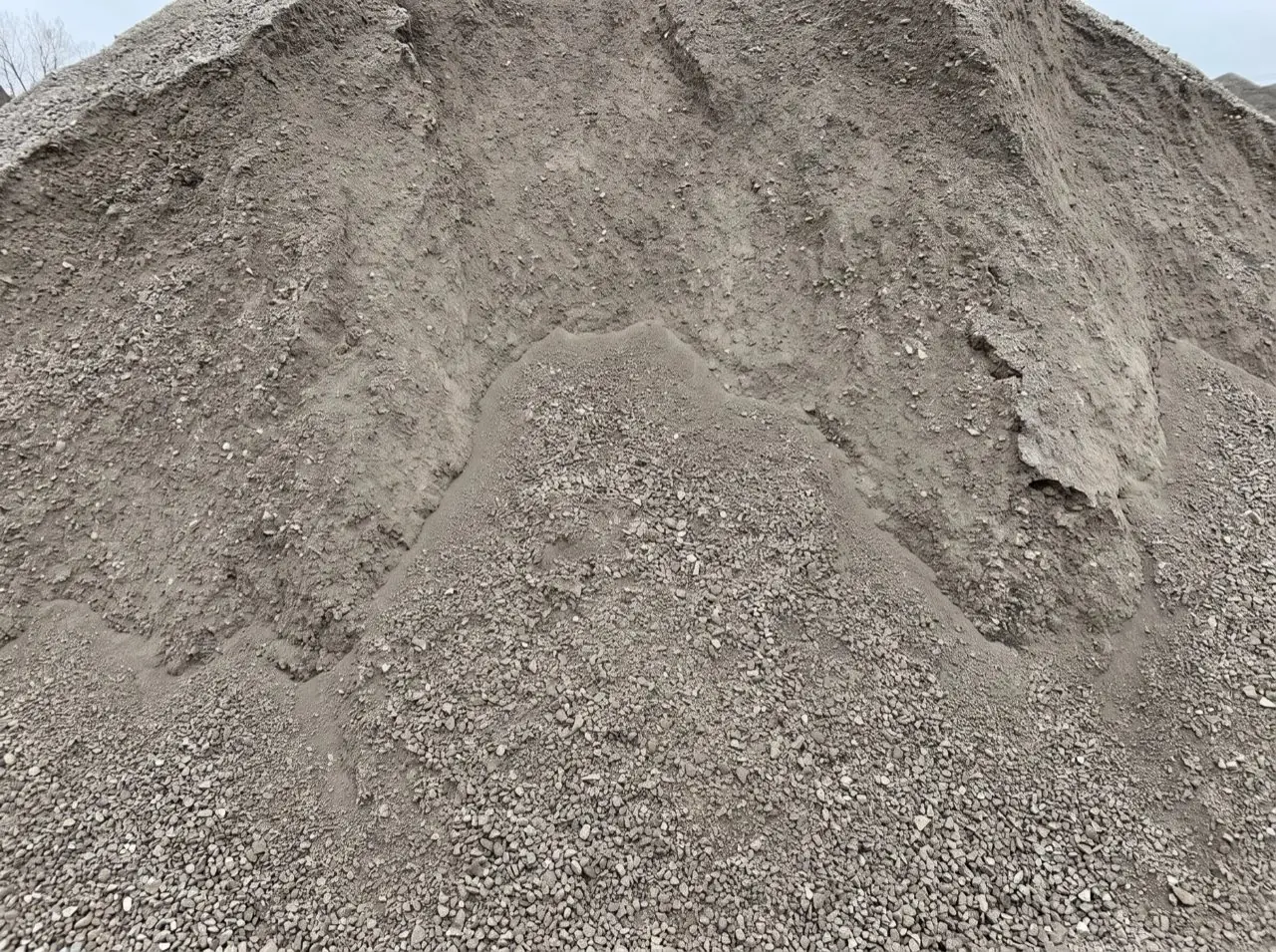
Limestone screenings is what falls through the screens when quarried limestone gets crushed and sorted. The primary crusher produces chunks of stone in various sizes. Those chunks go through screens — mesh separators — that catch material above a certain size and let everything smaller fall through. What falls through is limestone screenings: fine aggregate typically maxing out at 3/8 inch, mixed with stone dust and particles of every size below that threshold.
Because it's a byproduct of the primary crushing operation, screenings is consistently cheaper than sized aggregates. The quarry produces it whether it wants to or not — the demand for fine aggregate just has to show up to absorb it.
Missouri's extensive limestone quarry operations — including sources close to Festus and throughout Jefferson County — mean the material is reliably available and doesn't have to travel far. That keeps delivered cost low compared to regions where limestone isn't local.
Physical Properties That Drive Its Performance
Three things define how limestone screenings behaves on a job:
Angularity. Like all crushed stone, screenings particles are angular rather than rounded. Angular particles interlock under compaction; rounded particles roll against each other. This is why screenings compacts into a stable surface while sand — which is rounded — doesn't provide the same lockup.
High fines content. The stone dust fraction fills every void between the larger particles when compaction is applied. The result is a dense, tight mass rather than a porous aggregate layer. This is both a strength and a limitation: great for stability, slow for drainage.
Slight hardening after moisture cycling. Limestone screenings firms up noticeably after a few wet-dry cycles. The lime content doesn't cause it to cure like concrete, but it does create a surface that's meaningfully harder than gravel. Expect a well-placed walkway or paver base to feel almost solid underfoot after a season. It remains reworkable with hand tools, but it won't be as loose as the day it was delivered.
Where Screenings Performs Well
These are the applications where limestone screenings is often the best choice — not just an acceptable one:
- Paver and flagstone bedding layer. The paver industry standard calls for 1 inch of compacted, screeded bedding material under each paver. Screenings outperforms sand here because its angularity prevents lateral shifting under load. Most hardscape contractors in the St. Louis area use limestone screenings as their standard paver bedding material.
- Under concrete flatwork as a leveling course. A 1–2 inch screeded bed of screenings gives you a level, stable surface to pour on top of. It's not structural — the compacted base beneath it does that work — but it's forgiving to work with and gives the slab a clean bearing surface.
- Walking paths and garden paths. Screenings compacts firm under foot traffic, sheds water adequately, and stays in place better than pea gravel. It doesn't look fancy, but it produces a functional, low-maintenance path surface.
- Retaining wall block leveling course. The bottom course of a segmental retaining wall needs a level, compactable base. Screenings is commonly used for this application because it's easy to screede to grade and compacts tightly under the block weight.
- Drainage pipe bedding (non-critical applications). For utility and drainage pipe in residential applications where fast drainage isn't required, a bed of screenings supports the pipe uniformly and resists point loading. For applications where you need fast drainage around the pipe, use clean #57 stone instead.
The application it wins most clearly: paver bedding. Sand is the traditional material and it works, but it's susceptible to washout and lateral creep. Angular limestone screenings stays put. If you're installing a patio, walkway, or stepping stone path in Jefferson County, screenings is worth the conversation with your supplier before defaulting to sand.
Where Screenings Underperforms
Being honest about where a material falls short is more useful than overselling it:
- High-traffic driveways. Screenings is too fine to stand up to repeated vehicular traffic as a surface material. Tires displace it, rain concentrates ruts, and it migrates to the edges over time. For a primary driveway, use crusher run as the base and a coarser stone on top.
- High-drainage applications. The fines that make screenings compact well also dramatically reduce its drainage rate. Don't use it around foundation walls, in French drains, or anywhere water needs to move through the aggregate quickly. Use clean #57 or pea gravel for those applications.
- Areas with dust sensitivity. When dry and disturbed — by wind, traffic, foot traffic — screenings generates fine dust. On a garden path this is irrelevant. Near an HVAC intake or in a garage with finished floors, it's worth considering before specifying.
Screenings vs. Sand: The Paver Bedding Question
Sand is what most DIY guides recommend for paver bedding because it's universally available, easy to screede, and familiar. It works. But it has two vulnerabilities that limestone screenings avoids:
| Property | Coarse Sand | Limestone Screenings |
|---|---|---|
| Particle shape | Rounded — slides under stress | Angular — interlocks under stress |
| Washout resistance | Moderate — migrates under sustained water flow | Better — angular particles resist migration |
| Lateral stability | Can creep at edges over time | Stays put better; firms after moisture cycling |
| Ease of screeding | Very easy | Easy — slightly stiffer to work than sand |
| Cost in Missouri | Comparable | Often cheaper per ton at local yards |
For most paver installations in the St. Louis metro, screenings is the contractor preference. Sand remains appropriate for polymeric sand joints (filling between the pavers) — that's a different application than the bedding layer.
Calculating How Much to Order
Screenings is sold by the ton. To convert your project area into tons:
Length (ft) × Width (ft) × Depth (in) ÷ 12 ÷ 27 = Cubic yards
Cubic yards × 1.4 = Approximate tons
The 1.4 density multiplier reflects screenings' high fines content — it's heavier per cubic yard than coarser aggregates.
Common depth references:
Paver bedding layer: 1 inch (screeded and leveled before paver placement)
Garden path or walkway surface: 2–3 inches compacted
Under concrete leveling course: 1–2 inches
Retaining wall block base: 2–3 inches compacted
Example: A 200 sq ft patio at 1-inch paver bedding depth:
200 × 1 ÷ 12 ÷ 27 = 0.62 cubic yards × 1.4 = 0.87 tons — round up to 1 ton for working room.
If you're also calculating fill or topsoil for a concurrent project, the process is similar — see our guide on fill dirt vs. topsoil for how those materials are typically estimated and ordered.
Frequently Asked Questions
Is limestone screenings the same as stone dust?
They're often sold interchangeably and most buyers use the terms for the same product. Technically, stone dust is the pure fine material — the powder fraction only — while screenings includes fines mixed with some small aggregate up to 3/8 inch. In practice, what's sold at Missouri yards as "limestone screenings" is the same product most people mean when they ask for stone dust. If you need to be precise, ask your supplier what gradation they carry under each name.
Can I use limestone screenings as a driveway base?
As a base course under a coarser surface material, yes — it compacts well and creates a stable platform. As the finished driveway surface, it works for lightly used residential lanes (a car or two per day) but will displace under heavy or frequent traffic. For a primary driveway that sees regular use, top the screenings base with crusher run or #57 stone to give vehicles a surface that won't rut.
Does limestone screenings get hard?
It firms up significantly after compaction and several wet-dry cycles, but it doesn't cure like concrete. The lime content causes a mild chemical hardening — enough that you'll notice the difference between freshly placed and year-old screenings — but the material remains workable with a metal rake and doesn't require breaking up to regrade. Think of it as "firm aggregate" rather than "soft concrete."
How deep should limestone screenings be under pavers?
The standard in the paving industry is 1 inch of screened, leveled screenings under the paver itself. The structural work is done by the compacted base beneath that — typically 4–6 inches of crusher run or processed stone, compacted in lifts. The screenings layer is a precision-grade bedding, not a structural layer. Getting that 1-inch depth consistent across the entire installation is what keeps pavers from rocking or settling unevenly.