
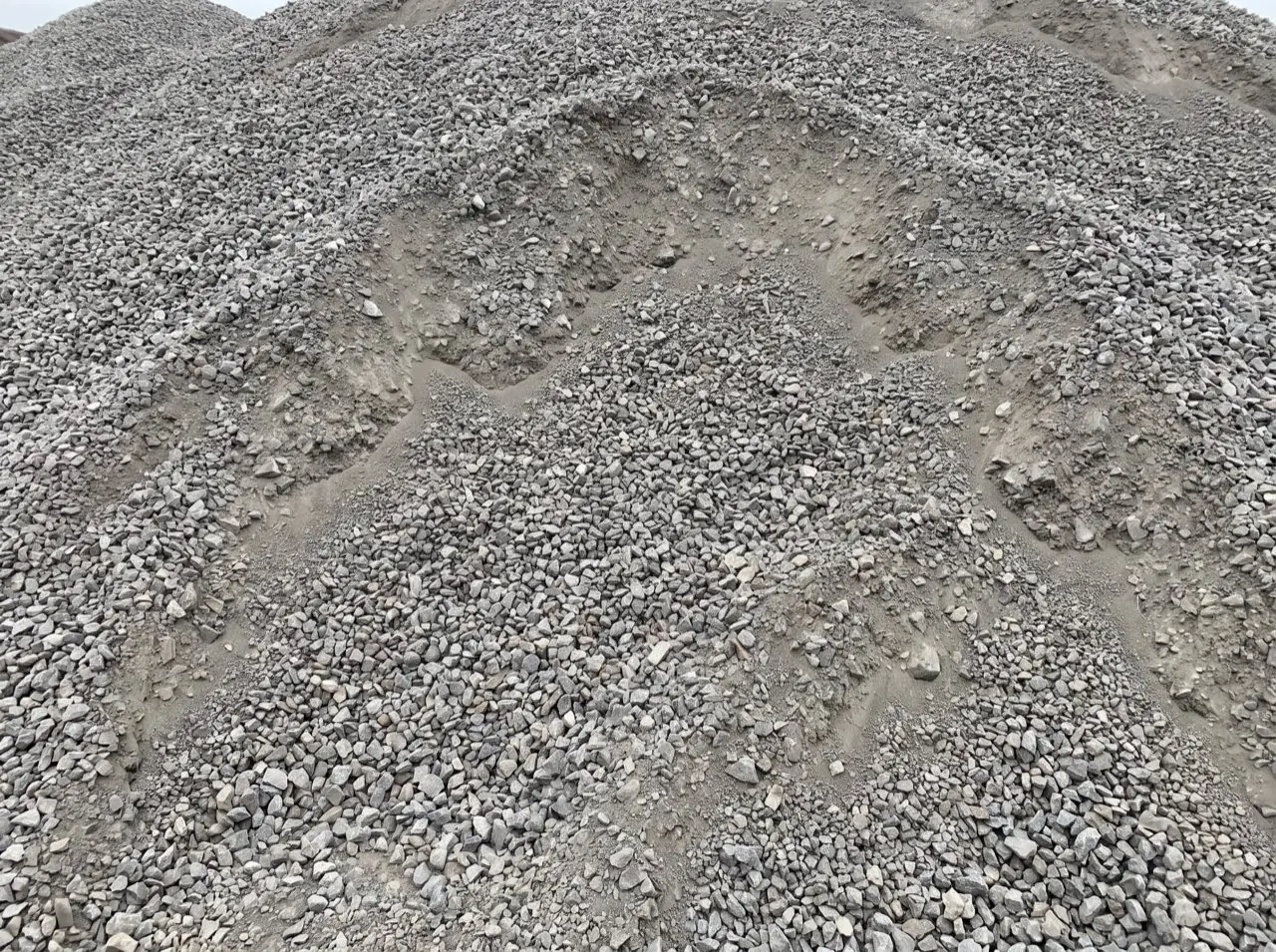
What is the best gravel for a driveway?
For a Missouri driveway, the best build is 4 to 6 inches of compacted crusher run as the base, topped with 3 inches of #57 limestone. The crusher run packs into a firm base over clay soil, and the angular #57 locks together under tires where rounded pea gravel would roll away.
What to order for each layer
| Material | Use it for | Drains? | Cost |
|---|---|---|---|
| Crusher run | Base layer, 4 to 6 inches compacted | Poorly, by design | $$ |
| Bank run gravel | Economy base for long rural drives | Moderately | $ |
| #57 limestone | Surface layer, 3 inches | Very well | $$ |
| Pea gravel | Paths, decorative beds, drainage. Not driveways. | Very well | $$ |
Why clay ground changes the answer
Jefferson County soil is clay-heavy, and clay holds water. When saturated clay freezes it expands, and when it thaws it contracts. A typical Missouri winter brings 20 to 30 of these freeze-thaw cycles through December, January, and February. Loose round stone on wet clay migrates with every cycle. Angular stone that interlocks stays put.
That is why a driveway here needs two layers: a compacted base for stability, and a surface layer for traction and drainage.
Base layer choices
Crusher run, also called ¾" minus or road base, is crushed limestone or granite with every size from ¾-inch pieces down to fine dust (the fines). Compacted in 4-inch lifts, the fines fill the gaps and the layer locks up nearly solid. It does not drain freely, which is fine for a base: the base is there for stability. It is the standard driveway base in Jefferson County.
Bank run gravel is pit gravel as it comes out of the ground: sand, small stones, and some fines, uncrushed. It costs less and works for residential driveways without tight specs, such as a long rural drive. Its makeup varies more, so if you need consistent compaction or the site has poor drainage and clay problems, step up to crusher run.
Repairing a driveway? Check why the potholes keep returning before ordering another surface load. Persistent water or a weak base may need work first.
Surface layer choices
#57 limestone is ¾-inch clean angular stone with almost no fines. It is the most-ordered driveway surface in this area. The angular pieces interlock under tires so the surface stays put, it drains well, handles freeze-thaw, and is easy to top up as it thins.
Pea gravel is ⅜-inch smooth round stone. It cannot interlock, so it shifts under vehicles and ends up in the lawn and swales. Keep it for walking paths, decorative beds, splash blocks, and drainage. For a firm path or paver base, limestone screenings is the better choice.
How much do I need?
Length (ft) × Width (ft) × Depth (inches ÷ 12) ÷ 27 = cubic yards
Example: a 100 by 12 foot driveway with a 6 inch crusher run base is 100 × 12 × 0.5 ÷ 27 = about 22 cubic yards. The 3 inch #57 surface is about 11 cubic yards. Add 10% for waste and settling: about 24 yards of base and 12 yards of surface stone.
Stone is usually sold by the ton. #57 limestone weighs about 1.4 tons per cubic yard and crusher run is similar, so multiply cubic yards by 1.4. The driveway gravel calculator does both layers at once and converts the result to quad-axle truck loads.
Delivery from J1S
J1S stocks crusher run, #57 limestone, bank run gravel, and pea gravel at the Festus yard, with same-day delivery available throughout Jefferson County. We run quad-axle dump trucks for larger orders and smaller trucks for smaller quantities. Call to confirm availability and pricing; both change with the market.
Common questions
How deep should driveway gravel be?
Install 4 to 6 inches of compacted crusher run as the base, then 3 inches of #57 limestone as the surface, about 7 to 9 inches in total. The base matters most. Skimping on it leads to rutting and heaving.
Crusher run or #57 stone?
Use both, in different layers. Crusher run (also called 3/4-inch minus or road base) has every size from 3/4-inch stone down to dust, so it compacts into a hard, stable base. #57 stone is clean 3/4-inch angular limestone with no fines. It does not compact solid, but it interlocks and drains well, which makes it the best surface.
Can I use pea gravel for a driveway?
It is not recommended. Round pea gravel cannot interlock, so it shifts and spreads under traffic, and on Missouri clay it migrates more every winter. Use angular stone like #57 limestone for the surface.
Comparing quarry names? See clean rock versus minus. For recurring ruts or washouts, review driveway grading and repair before ordering more stone.
Sources
- South Dakota LTAP for the Federal Highway Administration, Gravel Roads: Maintenance and Design Manual: bank run or pit run gravel is loaded without processing, and crushed, fractured stone resists movement under loads better than rounded stone (Section III, page 40; Appendix B, page B2).
- Missouri Department of Natural Resources, Limestone (PUB2902): Missouri limestone is crushed and screened into aggregate used for road surfacing and foundation support.