
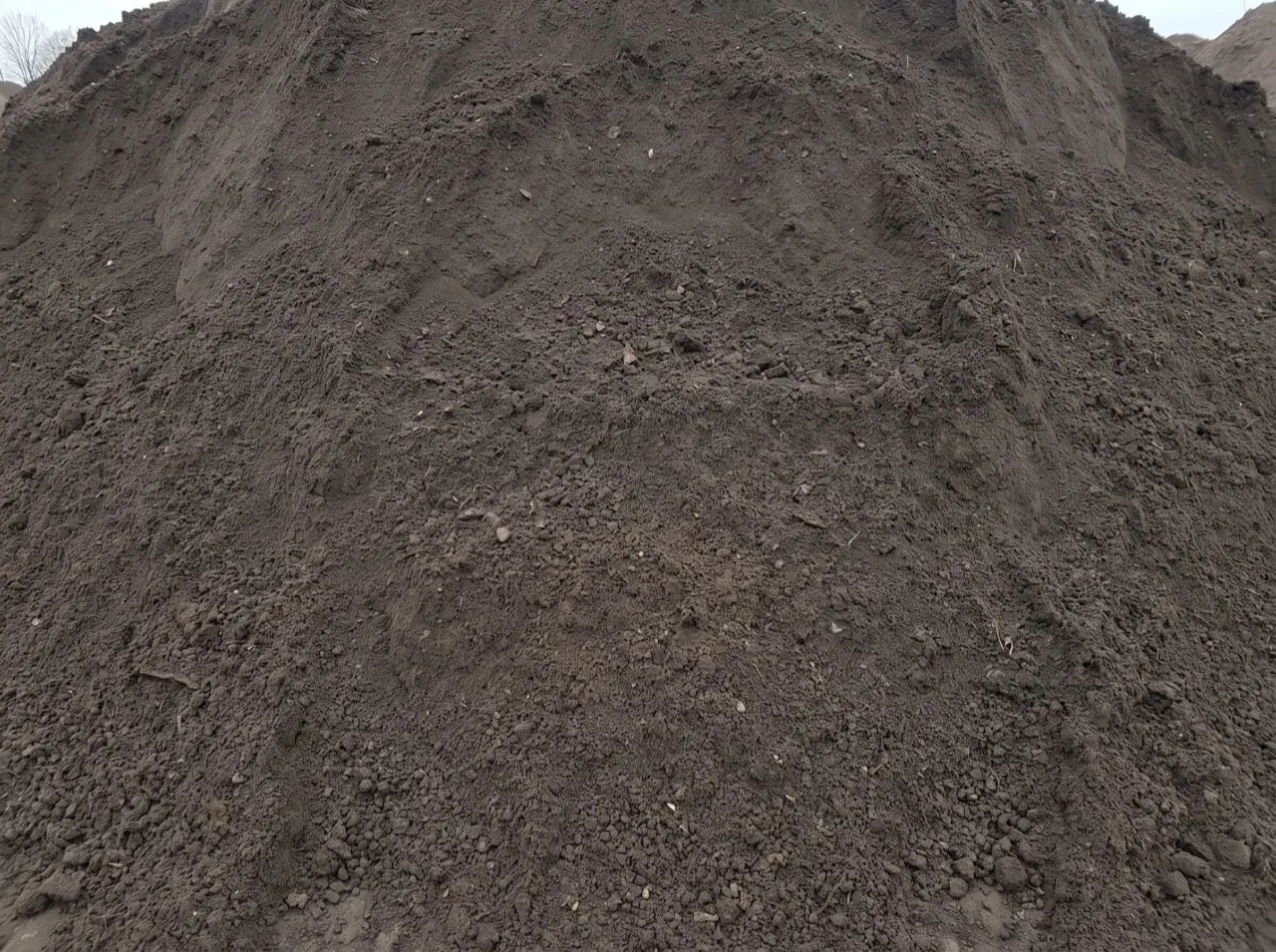
How much topsoil do I need?
Multiply the length by the width in feet, multiply by the depth in inches, and divide by 324 to get cubic yards. A 1,000-square-foot lawn at 4 inches deep needs about 12.3 cubic yards, and adding 10 percent for settling brings the order to about 13.6.
Skip the math: the materials calculator turns your area into cubic yards, tons, and truckloads, and drops the numbers into a delivery quote.
How deep should topsoil be?
| Job | Topsoil depth |
|---|---|
| New lawn, seed or sod | 4 to 6 inches |
| Garden and planting beds | 8 to 12 inches |
| Top-dressing an existing lawn | 1 to 2 inches, raked in |
| Filling low spots | Fill dirt to grade, then 4 to 6 inches of topsoil |
Under 4 inches on a new lawn, roots hit subsoil fast and the grass thins out in dry spells. If you are raising the ground more than 4 to 6 inches, use fill dirt for the bulk and finish with topsoil; see fill dirt vs. topsoil and how much fill dirt you need.
Cubic yards for common jobs
| Job | Area | Depth | Cubic yards |
|---|---|---|---|
| 10 x 20 raised bed | 200 sq ft | 12 in | 7.4 |
| Lawn repair | 500 sq ft | 4 in | 6.2 |
| 50 x 50 top-dress | 2,500 sq ft | 2 in | 15.4 |
| 100 x 100 top-dress | 10,000 sq ft | 2 in | 61.7 |
| Large grading job | 5,000 sq ft | 6 in | 92.6 |
These do not include extra for settling. Add 10 to 15 percent and round up.
The formula
Cubic yards = length (ft) x width (ft) x depth (in) / 324
Example: a 50 by 40 foot lawn at 4 inches deep is 50 x 40 x 4 / 324 = 24.7 cubic yards.
Why 324? There are 12 inches in a foot and 27 cubic feet in a cubic yard, and 12 x 27 = 324.
What J1S delivers
J1S quad-axle dump trucks carry 14 cubic yards per load, roughly 14 to 15 tons of screened topsoil depending on moisture. If your job is under 5 or 6 yards, call before ordering to ask about smaller loads or yard pickup. Screened topsoil has the rocks, roots, and clods taken out, so it rakes smooth for a lawn or bed.
Check access first. The truck needs a clear path with room overhead (watch branches and power lines), ground firm enough not to get stuck, and a way to turn around or back out. Wet ground or fresh digging can be a problem, so schedule in dry weather if you are unsure.
Why new lots need more topsoil
Jefferson County ground typically has 4 to 8 inches of topsoil over clay. Building often strips it, leaving many new lots with 0 to 2 inches over clay. Grass on that surface comes in thin and patchy, so plan on 4 inches of topsoil over the packed ground.
Common questions
Can I mix topsoil with existing soil?
Yes. For a new lawn, till the top 3 to 4 inches of existing soil, then spread 2 to 4 inches of screened topsoil on top. That improves the soil you have and cuts the amount you need to order.
How do I measure an odd-shaped area?
Split it into rectangles and triangles. Work out each rectangle with the formula, use base x height / 2 for each triangle, and add them up. That is close enough to order from.
Does topsoil settle after delivery?
Yes. Topsoil settles roughly 10 to 15 percent after watering, so a 4-inch layer ends up about 3.5 inches. Order 10 to 15 percent extra and grade slightly above your finished height.
Is the math different for fill dirt?
No. The formula is the same. Fill dirt is for raising grade, filling holes, and building up under slabs, and usually costs much less. Topsoil is for growing things.
Sources
- University of Missouri Extension, Improving Lawn and Landscape Soils: topsoil can be removed or buried during construction, which makes growing plants in the remaining soil more difficult, and lawns may be top-dressed with good topsoil.
- University of Missouri Extension, Cool-Season Grasses: Lawn Establishment and Renovation: excavated subsoil from a new home should be kept separate from topsoil, and lawns never develop to their full potential in poor-quality subsoil.