
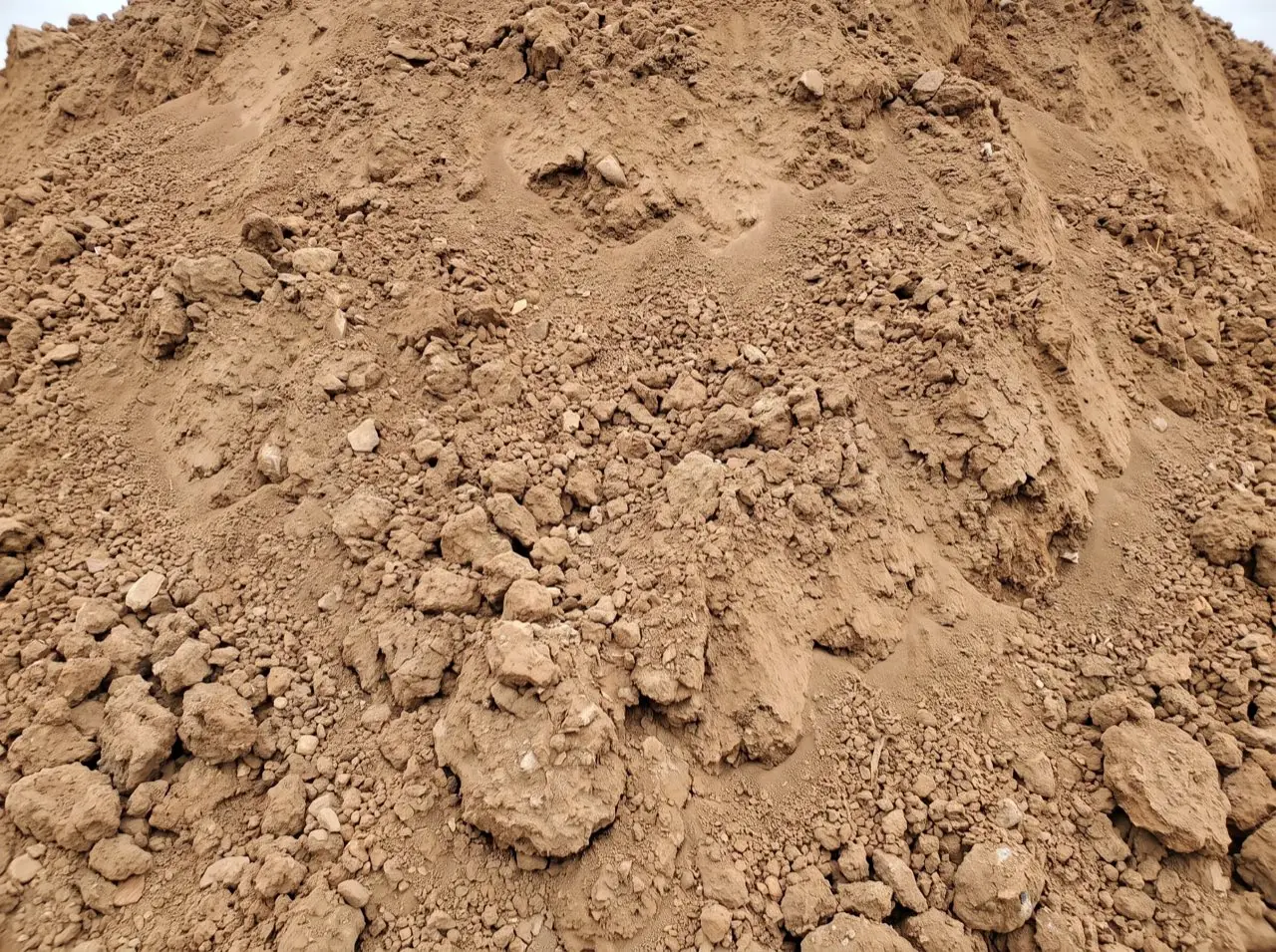
How much fill dirt do I need?
Multiply the length, width, and depth in feet, divide by 27 to get cubic yards, then multiply by 1.15 to allow for compaction. Filling a 20-by-30-foot area 6 inches deep takes about 13 cubic yards.
Skip the math: the materials calculator turns your area into cubic yards, tons, and truckloads, and drops the numbers into a delivery quote.
Cubic yards for common jobs
These already include the 15 percent for compaction.
| Job | Area | Depth | Cubic yards |
|---|---|---|---|
| Raise a 20 x 30 area | 600 sq ft | 6 in | About 13 |
| Fill a 10 x 10 low spot | 100 sq ft | 1 ft | About 4 |
| Foundation backfill, 100 ft long, 2 ft wide | 200 sq ft | 4 ft | About 34 |
| Raise a 50 x 50 area | 2,500 sq ft | 1 ft | About 107 |
The formula
Cubic yards = length (ft) x width (ft) x depth (ft) / 27 x 1.15
Example: 20 x 30 x 0.5 = 300 cubic feet. Divide by 27 and you get about 11.1 cubic yards. Add 15 percent and order about 13.
Convert inches to feet by dividing by 12 (6 inches is 0.5 ft, 18 inches is 1.5 ft). For an odd shape, split it into rectangles, work out each one, and add them up. Fill dirt is sold and delivered by the cubic yard.
Why add 15 percent?
Fill dirt settles 10 to 15 percent once it is placed and compacted, usually in 6-inch layers. A yard of loose fill becomes roughly 0.85 to 0.90 yards packed, and some soils settle as much as 20 percent. Coming up short costs another truck trip and often a delay, which is usually more than the extra dirt.
How many trucks will it take?
| Truck | Fill dirt per load |
|---|---|
| Quad-axle dump truck | About 14 to 16 cubic yards |
| Single-axle dump truck | 6 to 8 cubic yards |
Most home fill orders come on a quad-axle. If you need only 5 or 6 yards, call and J1S will send a smaller truck so you are not paying for a full load. For big jobs like foundation backfill, raising a site, or building a pond, we plan the loads around your total and your timeline.
How many tons is that?
Fill dirt typically weighs 1.3 to 1.4 tons per cubic yard, depending on moisture and soil. Multiply cubic yards by 1.35 for a working estimate: 20 cubic yards is about 27 tons. Trucks are loaded by volume, so order in cubic yards.
Fill dirt or topsoil?
Fill dirt builds up the ground; topsoil grows grass and plants on top of it. If you are unsure which you need, read fill dirt vs. topsoil, or figure the top layer with how much topsoil you need.
Common questions
How many yards in a dump truck load?
A standard quad-axle dump truck carries approximately 14 to 16 cubic yards of fill dirt per load. Smaller single-axle trucks carry 6 to 8 cubic yards. Most residential fill orders arrive by quad-axle truck.
How much does a yard of fill dirt weigh?
Fill dirt typically weighs 1.3 to 1.4 tons per cubic yard, depending on moisture content and soil composition. Use 1.35 tons per cubic yard as a working estimate.
How much will fill dirt settle?
Fill dirt typically settles 10 to 15 percent after compaction. That is why the formula multiplies by 1.15, so you order enough to reach your final height.
Sources
- NIST Handbook 44, Appendix C, General Tables of Units of Measurement: 12 inches equal 1 foot and 27 cubic feet equal 1 cubic yard, the conversions used to turn inches of depth into feet and cubic feet into cubic yards.